Philadelphia, United States · 6 min read
Most visitors arrive in Philadelphia's Old City chasing a single photo: a cracked bell, a brick hall, a founding father cast in bronze. But the real story here is smaller and stranger than the monuments suggest. This was a working port town of printers, carpenters, and seamstresses — and within a handful of blocks, those ordinary people hosted the loudest argument in American history.
What makes this quarter worth a slow afternoon isn't just that independence and the Constitution were debated here. It's that the same streets hold the contradictions the founders left unresolved — liberty proclaimed on a bell steps from a house where people were enslaved. If you want more than a selfie, Old City rewards you for paying attention.
Here's a highlights reel of the places that tell that story best, and how to walk them in one easy, mostly flat loop.
The Ordinary Building Where Everything Changed
Independence Hall doesn't announce itself as sacred ground. Red brick, white trim, a clock tower — it looks exactly like what it was: the Pennsylvania State House, a working colonial government building where tax disputes and land grants were sorted out. Nobody laid these bricks thinking they were building a shrine.
Then came the summer of 1776, when the Second Continental Congress crowded into the Assembly Room behind closed shutters and argued itself out of being British. Eleven years later, in that same room, another set of men spent a sweltering season inventing a constitution and quarreling over slavery, states, and who counts as a person.
The key word is argued — not decreed. A town of tradesmen hosted the debate that made a nation, and left plenty of it unfinished. (Note that stepping inside requires a separate timed ticket.)
Liberty for Whom?
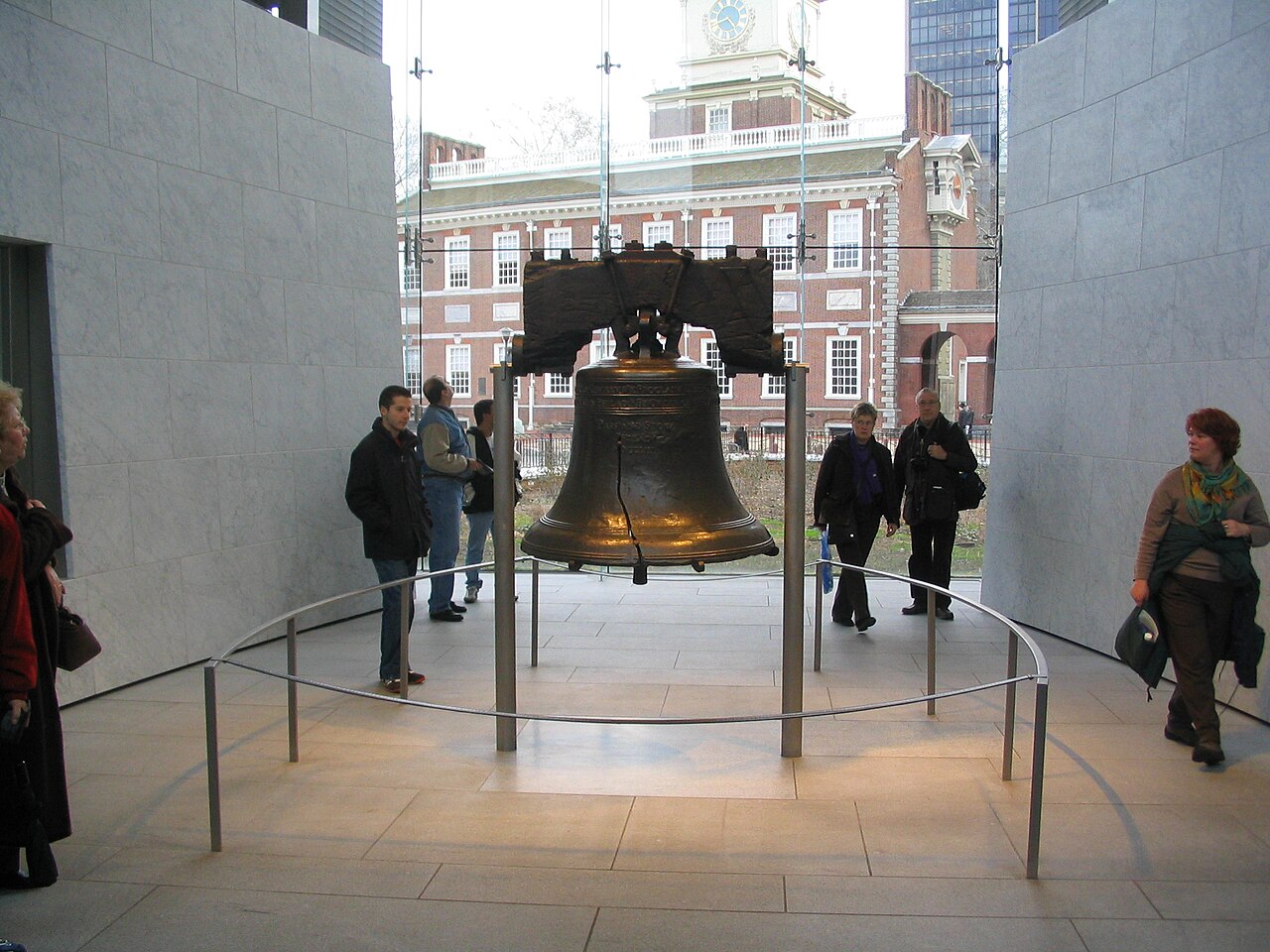
Bronze, pocked, and famously broken, the Liberty Bell was cast in 1752 for the State House tower, its inscription borrowed from Leviticus: 'Proclaim liberty throughout all the land.' The beloved stories around it are shakier than most visitors assume. Did it ring out on July 8, 1776 to summon the city? A lovely tale, almost certainly invented decades later. The crack? It widened over years of ordinary use and clumsy repair — no single dramatic moment.
The truth that matters is this: for its first eighty years, this was simply a statehouse bell. It became the 'Liberty Bell' only in the 1830s, when abolitionists seized that Leviticus line and asked the obvious question — liberty for whom? They made it a symbol of a promise not yet kept, which points directly toward the next stop on the walk.
The Ghost Mansion and the Woman Who Walked Out
Just steps from the Liberty Bell, a set of outlines traced into the pavement marks the President's House — the mansion where George Washington, and later John Adams, lived while Philadelphia served as the nation's capital. This is the honest heart of Old City, and the part most tours skip.
Washington held at least nine enslaved Africans in this house. Pennsylvania law said any enslaved person living in the state for six months became free, so he quietly rotated them across the state line to reset the clock — deliberately, to keep them enslaved. One of them, Oney Judge, sewed and waited on Martha Washington. In 1796 she walked out of this house and vanished north to New Hampshire. The Washingtons hunted her for years; she was never recaptured, and never regretted it.
Standing on this spot asks you to hold both truths at once: the man who led the argument for liberty enslaved people here. It isn't a footnote. It's the unfinished argument itself.
A Revolution Hosted by Tradesmen
Walk east down Chestnut and you'll find a trim brick hall set back from the street, belonging neither to a king nor a church but to carpenters. The Carpenters' Company — the guild of Philadelphia's master builders — put up this hall for themselves.
In 1774, when delegates from the colonies first came together as the First Continental Congress, they didn't convene in a palace. They borrowed this room from a tradesmen's guild. The men who designed moldings and raised roof beams handed their hall to the men debating empire.
That's the thread running through these blocks. We tend to picture the Revolution as gentlemen in powdered wigs, but it was hosted, fed, printed, and built by artisans. Franklin himself, just around the corner, started as a tradesman with ink-stained hands.
Franklin's House, Drawn in Air
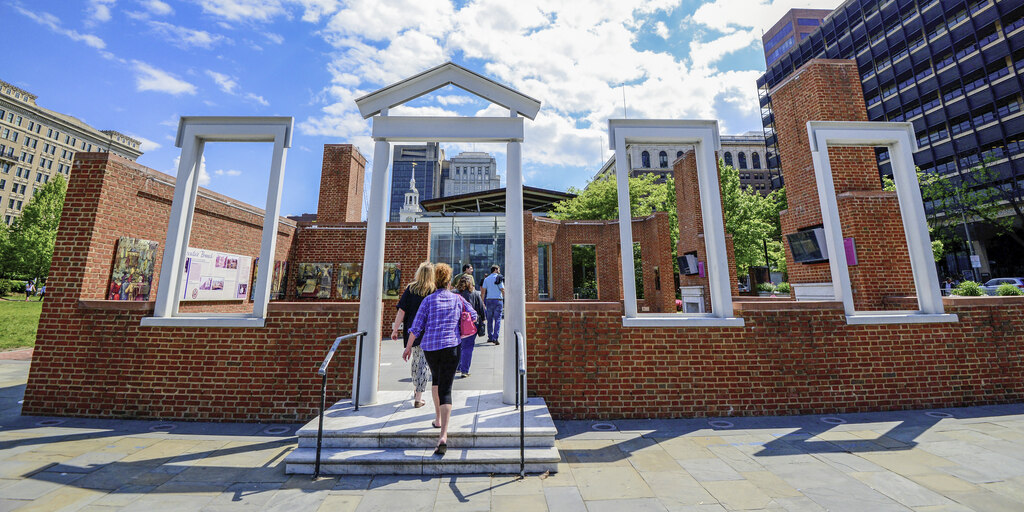
Through a quiet passage you arrive not at a house but at the idea of one: a steel frame open to the sky, tracing the walls of Benjamin Franklin's home. They call it the 'ghost structure.' The real house was demolished in 1812, so architect Robert Venturi drew it in air rather than guess at the vanished bricks — an honesty that suits the place.
Franklin lived, worked, and died here in 1790: printer, scientist, diplomat, the tradesman who dined with kings. But he deserves the same scrutiny as Washington. For decades he enslaved people in his own household and ran ads for the sale of human beings in his newspaper.
Only late in life did he turn, becoming president of an abolition society and petitioning Congress to end slavery. A man who changed his mind — in blocks full of people who couldn't, or wouldn't, that's worth pausing over.
The Legend That Honors the Right Hands
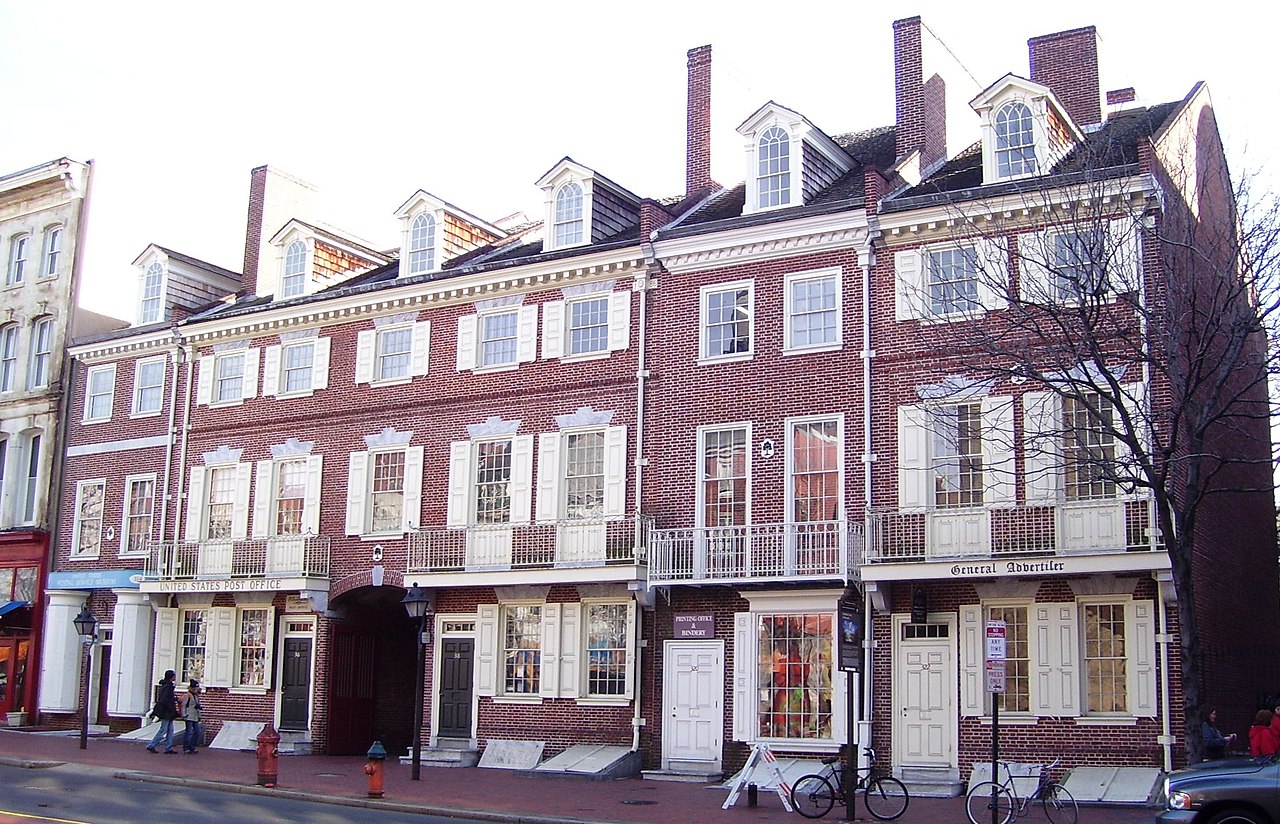
Up on Arch Street sits a small, low-doored house crowded among its neighbors, tied to Betsy Ross. Here it's worth separating the woman from the myth. The woman was real and entirely of this place: a working upholsterer who sewed, mended, and ran a shop, widowed young and keeping herself afloat with her needle in a city at war.
The legend — that George Washington called on her and she stitched the first Stars and Stripes — rests on a story her grandson told the public in 1870, nearly a century later. No document confirms it, and even whether she lived in this exact house is uncertain.
So take it as legend, not fact. But notice who the legend chose: not a general, not a signer, but a tradeswoman with a needle. Of all this quarter's myths, that one at least honors the right kind of hands.
Good to know
The full route runs about 0.9 miles, one-way, from Independence Hall to Elfreth's Alley — roughly 35–40 minutes of listening, more like a relaxed couple of hours if you linger. It's mostly flat on paved sidewalks, brick, and cobblestone, so wear comfortable shoes. The audio tour itself is free, but going inside Independence Hall requires a separate timed ticket, so book that ahead if you want to step in. Keep your voice down on Elfreth's Alley, where residents still live.
The full walk also passes Christ Church, Elfreth's Alley.
If this is the kind of history you want — the arguments and contradictions, not just the photo stops — the free self-guided audio tour 'Old City Philadelphia: Where a Port Town Argued Itself into a Nation' is the natural way to walk it. It threads all eight stops into one easy loop, from the Assembly Room to Elfreth's Alley, and tells you where the legends end and the harder truths begin. Pop in your headphones and let the city argue its case.
Take the free tour: Old City Philadelphia: Where a Port Town Argued Itself into a Nation →