Ithaca, USA · 5 min read
Some campuses have a signature building. Cornell has a landscape — two waterfall gorges, a glacier-carved lake valley, and bedrock older than the dinosaurs, all woven right through the middle of the university. Long before there was a college here, there was falling water doing the work of carving, and the famous local pun — 'Ithaca is Gorges' — turns out to be plain geological fact.
If you're weighing whether Ithaca is worth the trip, the honest answer is that it's one of the most dramatic walkable landscapes in the northeastern United States. You can stack six waterfalls, a swaying suspension bridge, a serene forest lake, and a 150-foot curtain of water into a single afternoon on foot.
This is a highlights guide to that walk — the deep-time story under your boots, where to stop, and how to see it safely.
Where the Gorge Meets the Town
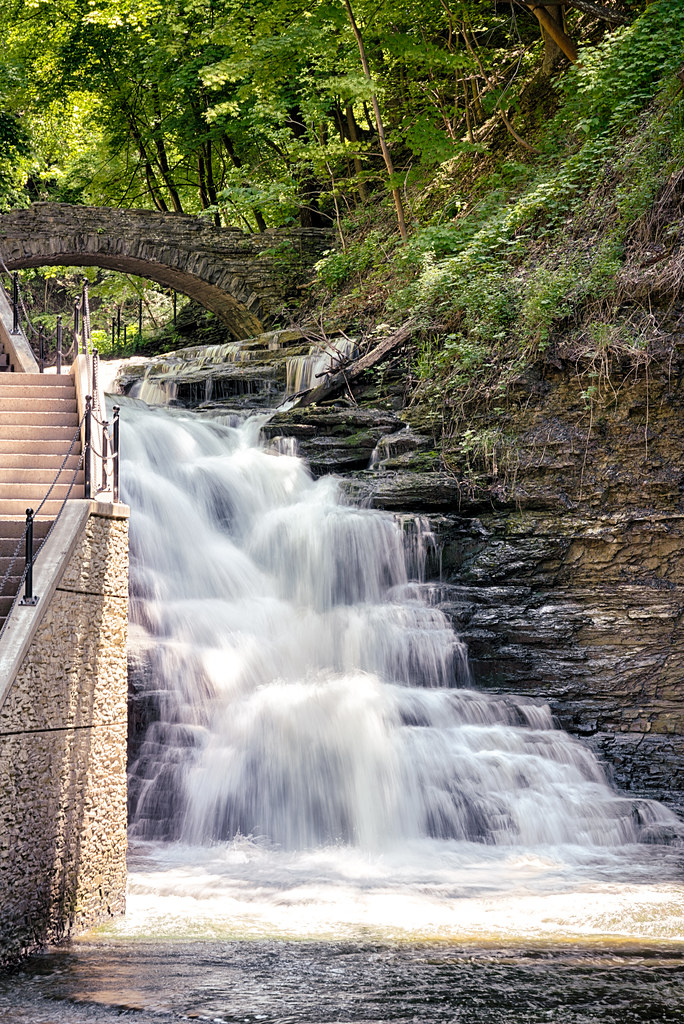
At the southern edge of campus, where Collegetown gives way to rushing water, Cascadilla Creek carves down through stone roughly four hundred million years old. This is Devonian shale and siltstone, laid down when the region was the floor of a warm inland sea — and the creek has been slowly unwrapping it ever since.
The climb itself is a piece of history. Hand-built stone stairs and trails, dating to the late 1920s, ascend more than 400 feet past six waterfalls, on land Robert Treman donated to Cornell in 1909 specifically so anyone could walk here. It remains one of the great free public experiences in the state.
A note for planners: Cascadilla is beautiful and genuinely dangerous. The trail closes seasonally (mid-December to mid-April), and a section between Stewart and College Avenue is closed for construction into spring 2026 — though lower-entrance views remain open. Stay on the marked path and behind every railing.
The Lake That Isn't a Lake
After the plunging drama of Cascadilla, Beebe Lake is the exhale. Spread across the heart of campus, it isn't a natural lake at all but a calm sheet of water held back behind a dam — a deliberate pause in a creek that spends most of its life falling.
A level, shaded one-mile loop rings the shoreline, threading through stands of old-growth forest and across the historic Sackett Bridge, with stone overlooks built expressly to slow you down. Watch for herons in the shallows and turtles sunning on fallen logs.
It's the serene counterpoint to everything around it — but only briefly. Just downstream, all this gathered water pulls itself together and drops.
The Falls That Once Ran Machines
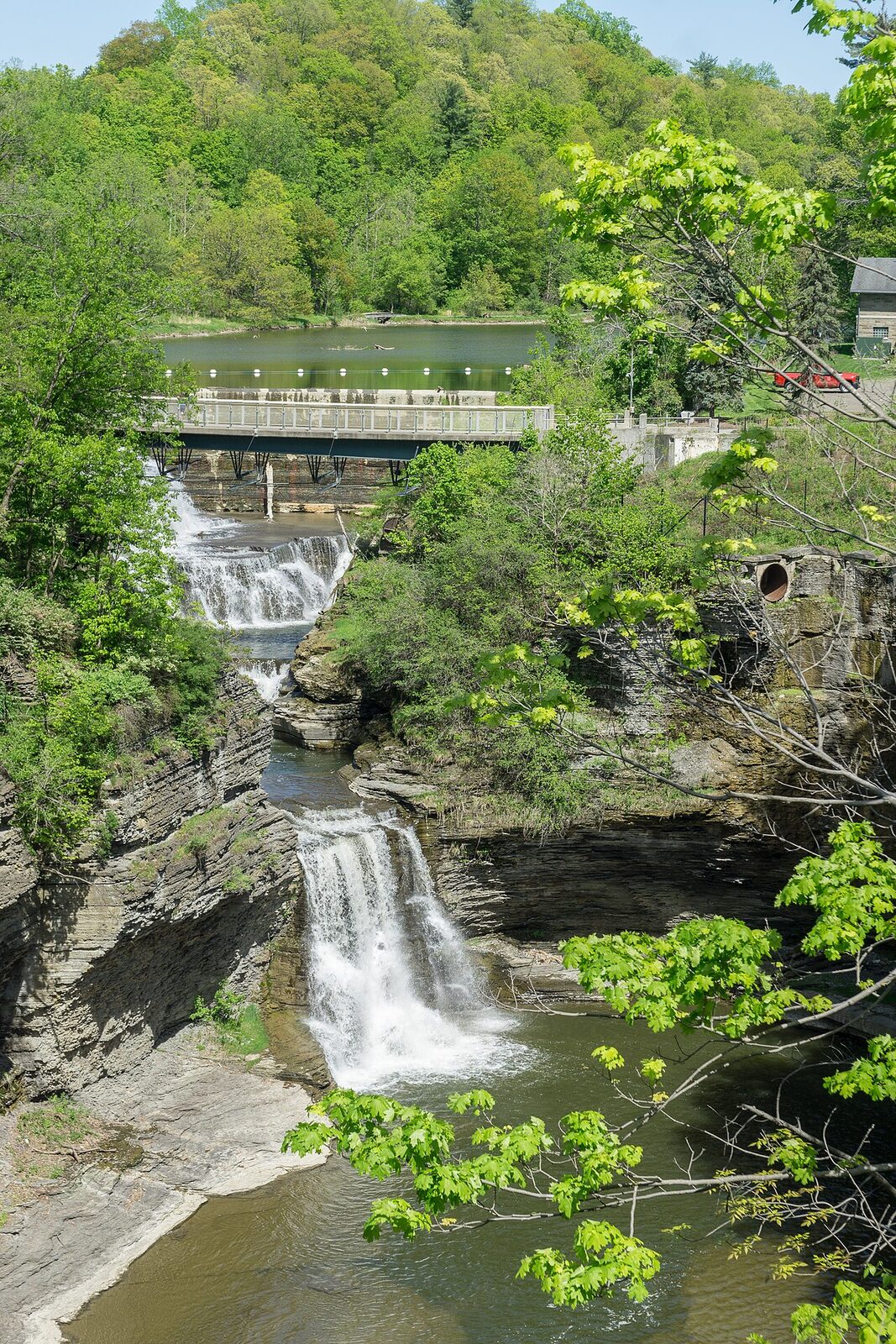
At the Beebe dam, the held water finally lets go: an eighty-foot drop best seen from the Triphammer Footbridge, part concrete dam edge and part natural rock cascade beneath it. The name carries the whole story — a trip-hammer was a water-powered forge hammer, and this stretch of Fall Creek once drove wheels and machinery.
Long before the campus rose, the sheer force of the water here meant work: grinding, sawing, forging. The gorge was an engine, not just a view. Standing on the bridge, you feel the same creek you watched resting on Beebe Lake now thundering over the edge — the first of the great Fall Creek drops that lead all the way down to the city.
Two Hundred Feet Straight Down
The slender pedestrian suspension bridge over Fall Creek Gorge sways gently underfoot by design — and then you look down. The gorge falls away nearly two hundred feet through sculpted ledges of ancient Devonian rock, each shelf a record of a flood in deep time.
From up here you read the entire cross-section at once: layer on layer, the patient arithmetic of erosion written in stone. The approach from Fall Creek Drive is flat and step-free, so it's an easy place to linger.
Stay on the bridge and along the marked rim. The rock below is loose and the drop unforgiving — this is one to admire, never to scramble toward.
The Whole Story in One Window
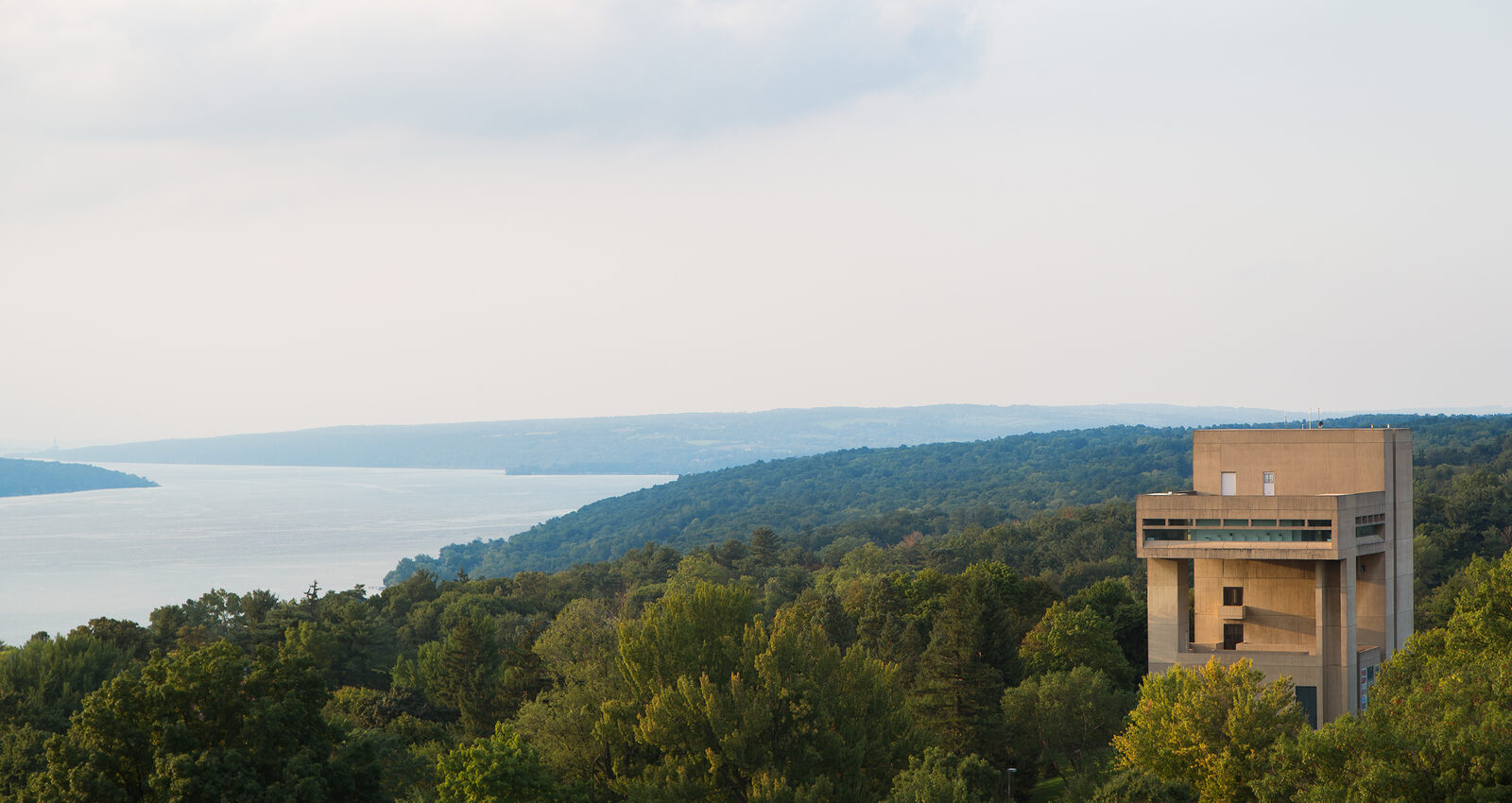
I.M. Pei's angular concrete Johnson Museum of Art, opened in 1973, is worth entering for the art — but the upper-floor windows deliver the single best overview of everything you've walked. From up there, Cayuga Lake fills a valley that glaciers gouged and deepened during the last ice age, a long finger of water in a trough of ice-carved rock.
The real revelation is how the gorges enter high on the valley walls, spilling down as if hung above the lake. Geologists call them hanging valleys: the main glacier cut the big valley faster and deeper than the small creeks could keep pace with, leaving them to leap at the end.
Cascadilla, Fall Creek, the falls, the lake — the entire geological narrative of the walk sits in a single frame here. It's the ideal place to grasp the whole before descending to its finale.
The Grand Finale in the City
The walk ends down in the city, out of the campus entirely, at Ithaca Falls — a broad curtain of water some 150 feet wide and the last and largest of Fall Creek's six great drops. Stand back and the cool spray and roar fill the whole basin.
This is the same water you first met high above, resting on Beebe Lake, letting go at Triphammer, plunging past the suspension bridge. Here it makes its final leap toward Cayuga Lake and that glacier-carved valley. The site is city-owned and open to all — enjoy it from the marked viewing area, and keep off the slick rocks and out of the deceptively strong current.
It's the perfect punctuation to the saying that started it all: Ithaca is Gorges.
Good to know
Plan for a roughly 3.5-4 mile hike with real elevation change and a long, mostly downhill final leg (~1.5 miles) from the Botanic Gardens to Ithaca Falls. Bring water, sturdy shoes, and layers; the Cornell Botanic Gardens make a good midpoint rest. Check trail conditions before you go — Cascadilla Gorge closes mid-December to mid-April, with a construction closure between Stewart and College Ave into spring 2026. Always stay on marked rim trails and bridges, behind railings, and never climb toward the water.
The full walk also passes Cornell Botanic Gardens & Newman Arboretum.
If you want the deep-time story to unfold as you walk it, the free self-guided audio tour 'Cornell: Ithaca is Gorges' is the perfect companion — it narrates the geology, the waterfall history, and the safe overlooks stop by stop, from Cascadilla's stone stairs all the way down to Ithaca Falls. Load it up, lace your boots, and let the landscape tell its own 400-million-year story.
Take the free tour: Cornell: Ithaca is Gorges →