Ithaca, USA · 6 min read
Most Ivy League campuses grew out of centuries of tradition and a fairly narrow idea of who belonged there. Cornell was different from the day it opened. In 1865 a self-made telegraph magnate named Ezra Cornell teamed up with a young scholar named Andrew Dickson White and made an audacious pledge: to build a university where 'any person can find instruction in any study.' Then he put it on a windswept farm hill high above Ithaca and Cayuga Lake.
If you're deciding whether Cornell's central campus is worth an afternoon of your visit to Ithaca, the answer is yes — and not just for the views (though the views are spectacular). The Arts Quad packs the entire founding story into a few hundred yards of grass, stone, and bronze.
Here's what makes this hilltop worth the climb, and how to read the campus like someone who knows its secrets.
The View That Started a University
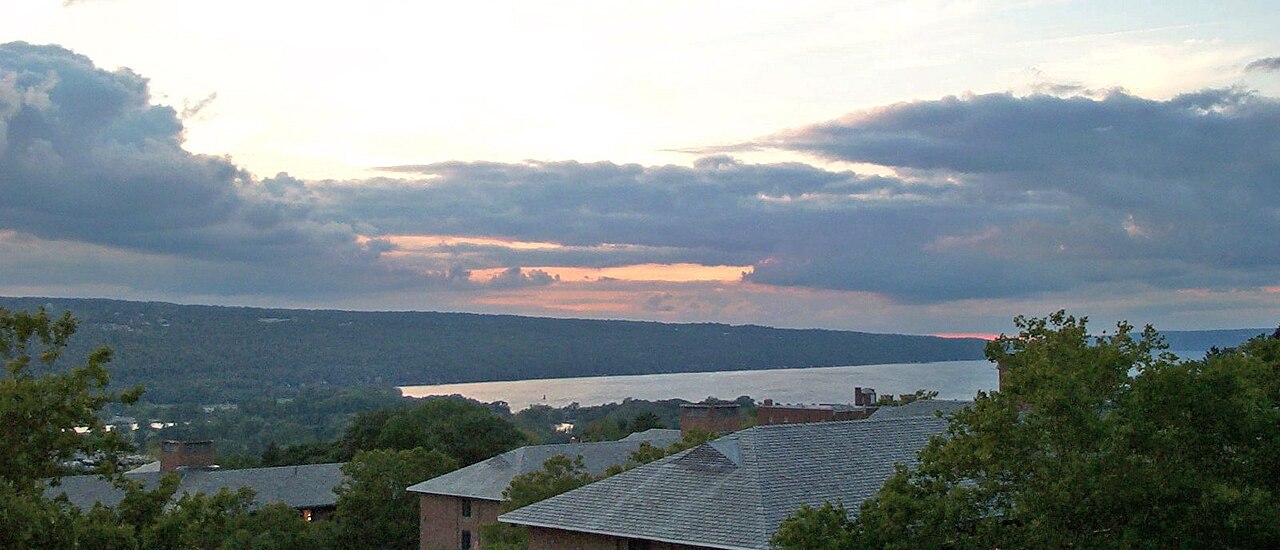
Everything on this hill begins with a view. Libe Slope falls away to the west, a broad green ramp that ends at the silver line of Cayuga Lake and the whole valley opening beyond it. When Cornellians sing 'far above Cayuga's waters,' this is the scene they're picturing.
The location wasn't an accident. This was Ezra Cornell's farm, and when skeptics asked why he'd build a university so far above the town, he simply pointed at the lake and the sky. He wanted his students looking out at something vast every single day. Come at sunset if you can — the light spills up the slope and the valley glows, and it becomes obvious why he never considered building anywhere else.
Old Stone Row and the Class of 1868
Facing the Quad is Morrill Hall, the oldest building on campus and part of Old Stone Row. When Cornell opened its doors in 1868, 412 students walked in that first day — the largest entering class any American university had seen to that point. Picture the noise, the mud, the unfinished rooms, and the sheer improbable ambition of it all.
And crucially, these weren't only the sons of the wealthy. Ezra's promise — any person, any study — meant farmers' children, working people, and soon women too, learning alongside everyone else. In 1868 that was radical. The walls were quarried nearby and raised on the very hill you've just admired: solid, unpretentious, and built to last, much like the man who paid for them.
The Carpenter Who Founded a University
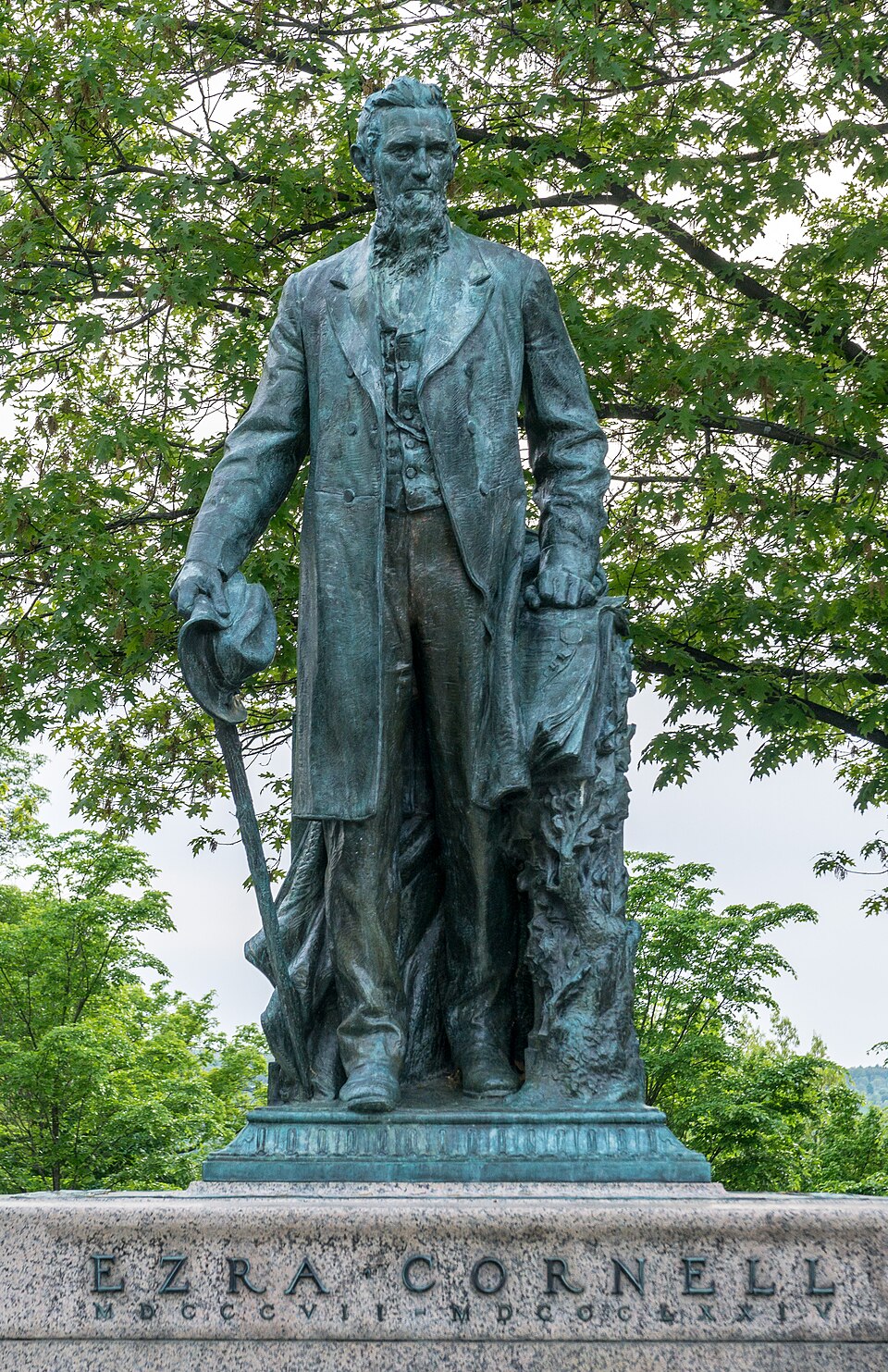
Cast in bronze on the Quad stands Ezra Cornell himself — no scholar's robes, just a plain coat and a steady, practical gaze. That plainness is the point. Ezra had little formal schooling. He worked as a carpenter and a mechanic before making his fortune stringing telegraph wire across a young nation as a founder of Western Union.
But money alone never interested him. He wanted to leave something that would outlast him, and he distilled the whole idea into one unforgettable sentence: 'I would found an institution where any person can find instruction in any study.' In an era when universities taught a narrow classical curriculum to a narrow set of men, Ezra imagined the opposite — engineering beside literature, agriculture beside philosophy, and open to all. His statue still watches over the Quad, as if checking that the promise held.
The Scholar Across the Grass — and a Midnight Legend
Seated across the Quad, facing his friend, is Andrew Dickson White, Cornell's first president and the other half of the partnership. If Ezra was the self-made man of action, White was the cultivated, well-traveled historian who had studied in Europe. Ezra supplied the fortune and the vision; White supplied the scholarship to turn it into a functioning university. Together, the telegraph magnate and the scholar-president are why the promise actually worked.
Notice how the two statues face each other across the grass. Generations of students have told a fond legend about this: that at the stroke of midnight, when the Quad empties out, the founders climb down from their pedestals, stroll to the middle, and shake hands — still keeping an eye on the university they made. No one has ever proven it, and no true Cornellian would swear it isn't true.
Chimes, a Reading Room, and a Very Famous Pumpkin
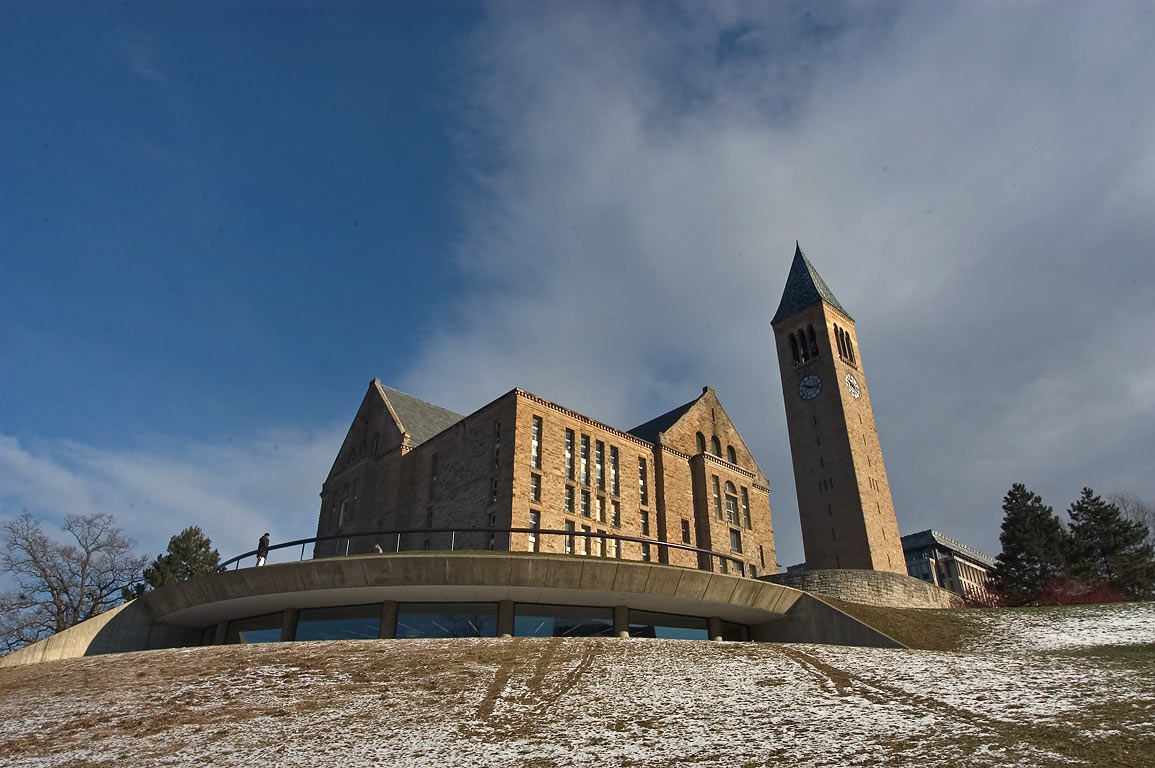
Rising over the Quad is McGraw Tower, and if you time your visit right you'll hear its twenty-one bells. They're still rung by hand by student chimesmasters who climb the tower for three concerts a day when classes are in session — one of the oldest such traditions in the country and, effectively, the campus heartbeat.
The tower has its lore, too. One October morning in 1997, students woke to find a pumpkin impaled on the very tip of the spire, more than 170 feet up. No one ever confessed how it got there, and it stayed for months. Just below the tower, step into Uris Library to find the A.D. White Reading Room — soaring, hushed, wrapped in iron balconies and old books. It may well be the most beautiful room on the hill.
Where 'Any Study' Becomes a Class Schedule
On the east side of the Quad stands Goldwin Smith Hall, the humanities heart of Cornell. It's easy to imagine the 'any study' half of Ezra's promise as laboratories and workshops — Cornell was a pioneer in the practical sciences. But the founders meant the humanities just as fiercely, and behind these columns live the classics, literature, history, philosophy, and languages.
The building honors Goldwin Smith, an English historian drawn to Cornell in its early days by exactly that openness. Inside you'll find lecture halls and a plaster cast collection of ancient sculpture — a quiet reminder that this place set the study of Homer beside the study of engineering and called both worthy. This is where the slogan stops being a slogan and becomes a course catalog.
Good to know
The full loop around the Arts Quad is short — well under a mile — and easily done in an hour, or longer if you linger in the Reading Room and Sage Chapel. It's an easy, mostly flat walk once you're on top of the hill, though the climb up from downtown Ithaca is steep, so wear comfortable shoes. Aim for late afternoon so you can end near sunset on Libe Slope, and check whether the A.D. White Reading Room and Sage Chapel are open to visitors during your visit. Bring a layer — the hilltop is breezy year-round.
The full walk also passes Sage Chapel.
The easiest way to walk this story in the founders' footsteps is the free self-guided audio tour 'Cornell: Any Person, Any Study,' which guides you from the Cayuga view Ezra chose all the way to the chapel where both founders rest. Pop in your headphones, start at Libe Slope, and let the campus tell you how the Ivy League's most idealistic promise was made — and kept.
Take the free tour: Cornell: Any Person, Any Study →