New York, USA · 6 min read
Most visitors to Morningside Heights come for a quick look at the steps where Alma Mater sits and leave without realizing they've just walked across one of the boldest pieces of urban design in America. In the 1890s, while Princeton and Yale were busy dressing up in soot-darkened Gothic to look five centuries old, Columbia moved uptown and did something audacious: it built a Roman acropolis.
The architect Charles Follen McKim didn't scatter buildings across the hilltop. He hung an entire campus on a single monumental axis — a dead-level line of sight from Broadway climbing to a great granite dome — and made every building a well-mannered citizen of that larger order. It's the City Beautiful movement made real, a republic's answer to the medieval fantasy of its rivals.
If you're deciding whether Columbia is worth a detour on an Upper Manhattan afternoon, here's the case for wandering in — and the stories hiding in the brick and limestone that most passers-through never hear.
The Line That Runs the Whole Show
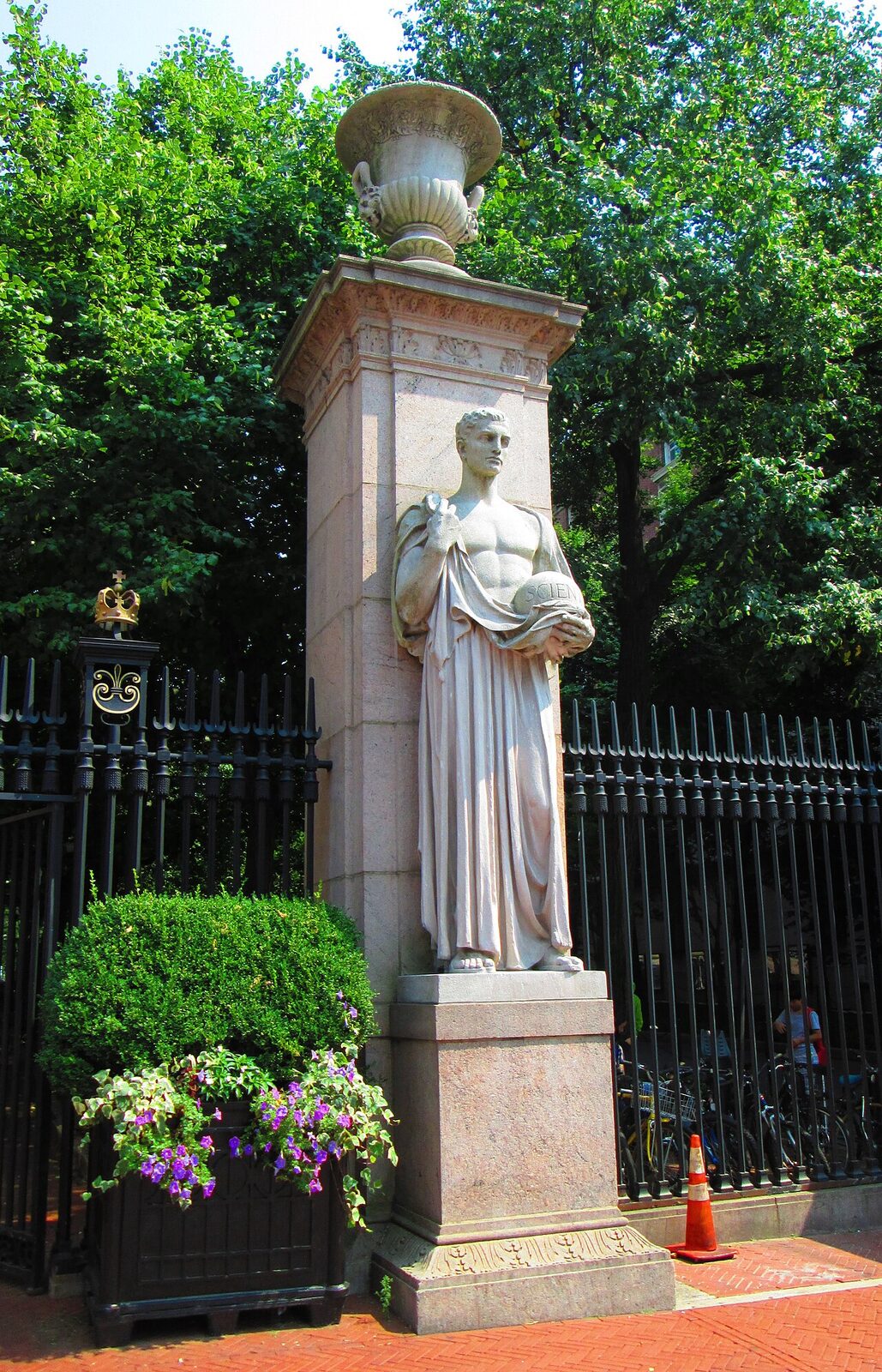
Stand at the edge of Broadway and look east through the gates, and you'll notice something oddly satisfying: a clean, level line running straight away from you along 116th Street. That's not luck. It's the spine of the entire campus, and everything McKim designed was arranged to serve it.
This is the City Beautiful movement in stone — the Gilded-Age conviction that order, symmetry, and grandeur could civilize a chaotic metropolis. Where Gothic universities reached for the medieval and the mysterious, Columbia reached for Rome: the forum, the temple, the acropolis. The ground even rises gently as you walk in, so you climb toward the summit. McKim wanted arrival to feel deliberate, civic, and proud, and it does.
A Temple to Reading, Built by a Gothic Architect
Fourteen giant Ionic columns march across the front of Butler Library like a Roman temple to books, its frieze carved with the canon: Homer, Herodotus, Sophocles, Plato, Aristotle, Cicero, Virgil. Grandiose? Unapologetically. That's the Columbia spirit in a single facade.
The delicious twist is who designed it. Butler, completed in 1934, is the work of James Gamble Rogers — the very same architect responsible for Yale's brooding Gothic towers pretending to be half a millennium old. At Yale he spoke medieval; summoned to Morningside, he switched fluently into Classical Latin. It's proof that these styles were a language architects chose to fit the argument they were making. Columbia's argument was Rome: clarity, daylight, and the temple front, with Butler facing Low Library across the South Lawn so the two anchor opposite ends of the axis.
The Thinker, and the Man Who Invented FM Radio
Out front of Philosophy Hall sits a bronze cast of Rodin's The Thinker, chin on fist — a perfect mascot for a building devoted to abstraction. But the philosophy is a bit of misdirection, because something very concrete happened inside these walls.
In the early 1930s, the engineer Edwin Howard Armstrong worked out frequency modulation here — FM radio, the clear, static-free sound most of us take for granted. It's a story of genius shadowed by grief: years of ruinous patent battles wore Armstrong down, and his life ended in tragedy. The building itself, meanwhile, quietly obeys the master plan, sitting in a mirrored pair with its neighbor across the lawn. In McKim's Columbia, no gesture goes without an answering gesture.
The One Building That Doesn't Belong
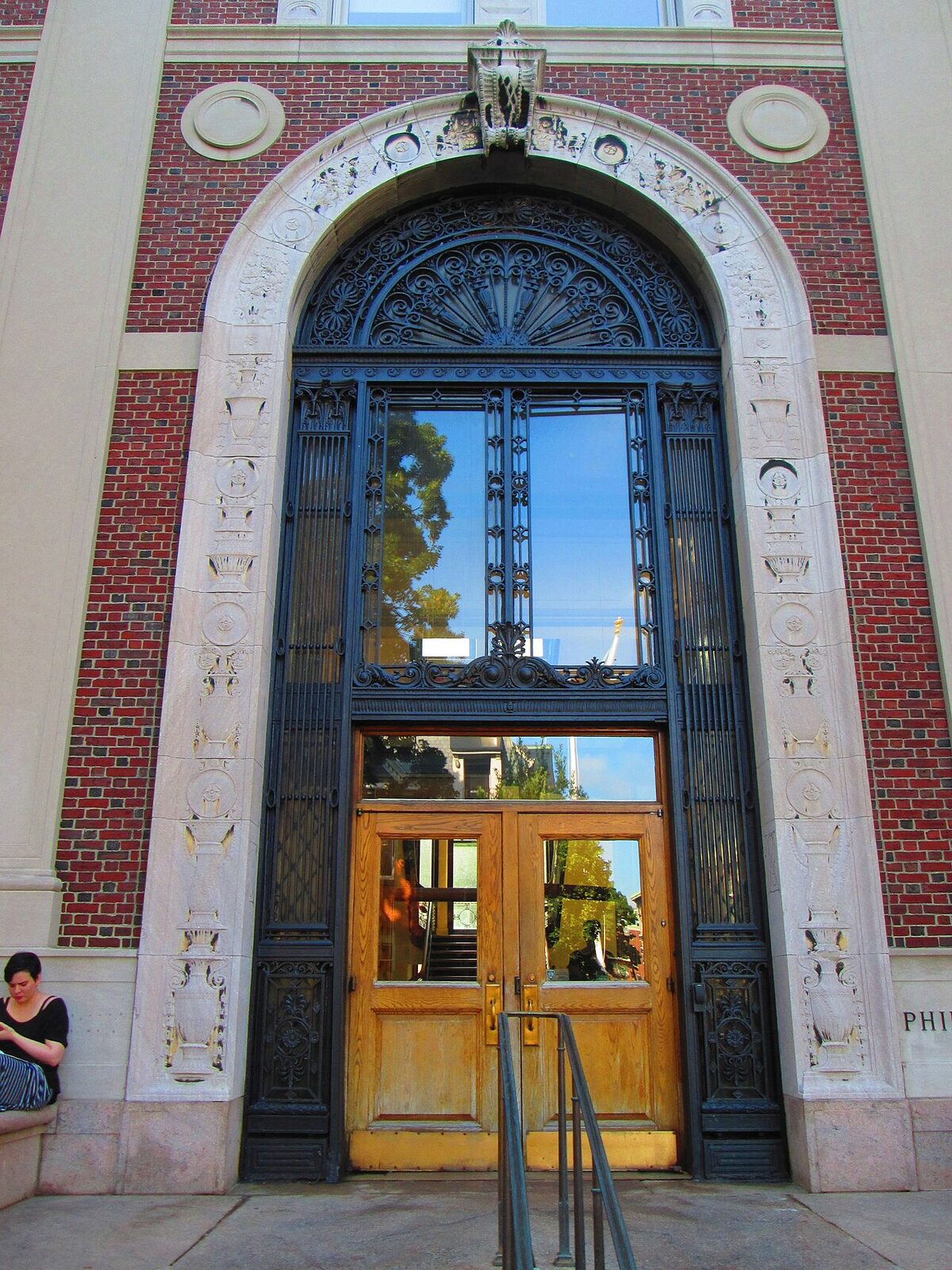
Amid all the columns and limestone stands a modest red-brick house in a French style that fits nowhere in the grand scheme. Buell Hall is the oldest building on campus — and the strangest — and it holds the secret buried beneath everything else here.
Before Columbia arrived in 1897, this hilltop wasn't empty. It was the Bloomingdale Asylum, a scatter of buildings among lawns and trees, chosen for the calm and clean air high above the crowded city. When the university bought the land, nearly all of it was swept away to clear the ground for McKim's Roman vision. Buell is the lone survivor: a single asylum building, spared and repurposed, standing quietly among the temple fronts. This pristine acropolis of order was raised, quite literally, over a vanished institution of suffering — and Buell is the one witness left to tell you so.
The Center That Became a Battleground
At the exact spot where the campus axes cross sits the Sundial. Look one way and the ground rises toward Low Library and its dome; look the other and it falls toward Butler and the South Lawn. This is the hinge of the whole plan — the point where, on a Roman forum, the two great streets would have met.
Because it's the center, it became the gathering place. Generations have met here to celebrate and to argue, most famously in the spring of 1968, when protests over the Vietnam War and a proposed gymnasium in nearby Morningside Park brought demonstrations, occupations, and police onto campus. There's an irony worth pausing on: architecture built to impose order became the stage on which people came to contest it.
The Summit, and the View Back Down
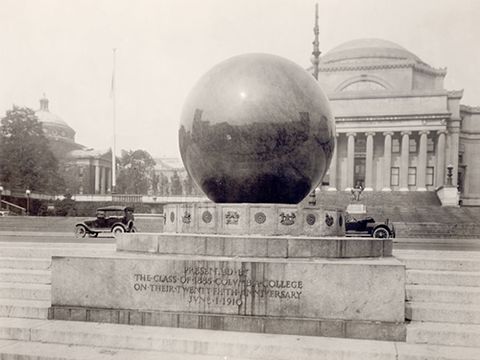
Climb the steps and you reach the payoff. Alma Mater, Daniel Chester French's serene bronze goddess of learning, presides with throne, scepter, and open arms. Behind her rises Low Library, McKim's 1897 masterpiece and the keystone of the entire design, crowned by the largest all-granite dome in North America — a direct descendant of Rome's Pantheon.
Then turn around. Look back down the axis: down the steps, across the lawn, to Butler's columned front answering from the far end. Temple facing temple, held on one unbroken line. That single view is the whole idea — order, symmetry, and civic ambition, a Roman city of the mind on Morningside Heights. The Gothic universities reached for the past to feel old; Columbia reached for Rome to feel eternal, and standing here, it's hard to argue it didn't work.
Good to know
The walk is short and flat-ish — roughly half a mile end to end, easily done in 45 minutes to an hour if you linger over the details, longer if you step inside St. Paul's Chapel to see the glowing Guastavino dome. The route runs from the Broadway gates at 116th Street up to the Steps of Low Library, so it's an easy add-on to a day around Morningside Heights or a visit to the nearby Cathedral of St. John the Divine. Wear comfortable shoes for the gentle climb, and try to go in daylight when the brick-and-limestone contrasts and the carved friezes read best.
The full walk also passes Journalism (Pulitzer) Hall, Hamilton Hall & the Hamilton Statue, Schermerhorn Hall, St. Paul's Chapel, Earl Hall.
The best way to unlock these stories on the ground is the free self-guided audio tour "Columbia: The Acropolis on Morningside," which walks you along McKim's monumental axis from the Broadway gates up to Alma Mater, connecting the architecture, the hidden asylum, and the campus's turbulent history stop by stop. Cue it up, start at the gates, and let the acropolis reveal itself.
Take the free tour: Columbia: The Acropolis on Morningside →