Berlin, Germany · 6 min read
Few cities wear their history as openly as Berlin. In the compact government quarter of Mitte, a glass parliament dome, a 1791 triumphal gate, and a field of 2,711 concrete slabs sit within a few minutes' walk of one another — monuments to ambition and monuments to atrocity, almost touching.
This is the part of the city where trip-planners ask themselves what's actually worth the time. The answer is: a single straight line, barely a mile and a half, that holds more twentieth-century history than most countries accumulate in a thousand years.
From the Spree riverbank to the quiet guardhouse on Unter den Linden, this route reads Berlin as a conversation between power and the people that power destroyed. Here are the stops that make it unforgettable.
The Crosses by the River
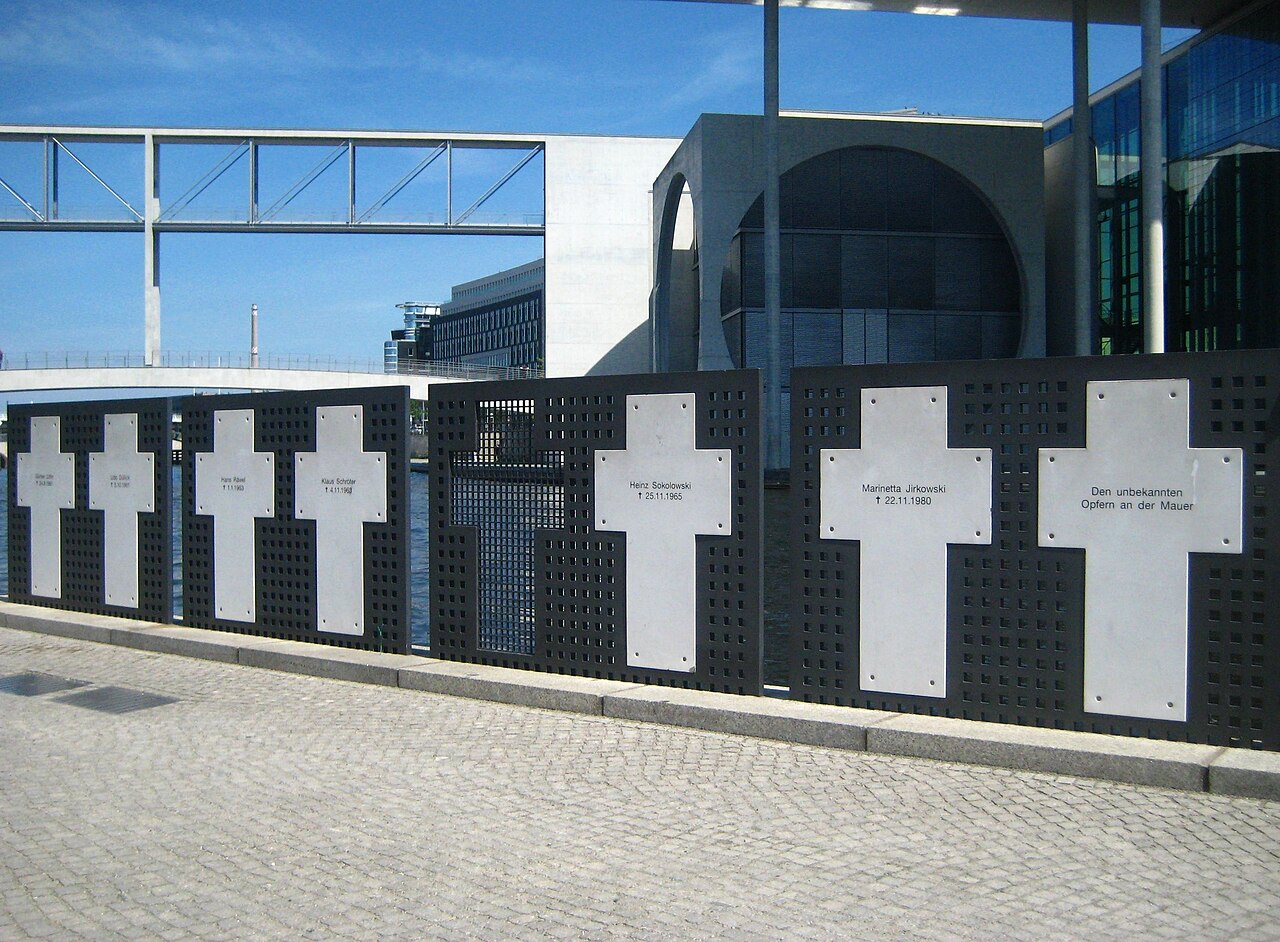
The walk begins at a place most visitors hurry past: a plain railing on the bank of the Spree, lined with simple white crosses. Each one names someone killed trying to cross the Berlin Wall, which ran right here, along the water, behind the great parliament building.
These were ordinary Berliners — Peter Fechter, Chris Gueffroy, and others whose names have faded from memory. Some drowned in this river; some were shot within sight of the West. The border did not skirt the edge of the city. It cut straight through its heart, past the very seat of German government.
It's a deliberately humble starting point. Before admiring the architecture of power, the walk asks you to remember what power can do to a single person trying to walk from one side of a city to the other — a thought that returns at every stop.
A Parliament Made of Glass
The inscription across the Reichstag's portico reads 'Dem Deutschen Volke' — 'To the German People' — added in 1916 by a Kaiser who distrusted the parliament beneath it. This single building witnessed the entire German twentieth century. In February 1933, weeks after Hitler became chancellor, fire gutted the chamber, and he seized on it as the pretext to suspend civil liberties overnight. A row of slate slabs near the corner names the parliamentary deputies the Nazis later murdered.
In 1945, Soviet soldiers fought room to room for the building and scrawled their names on its walls. When architect Norman Foster restored it, he chose to preserve that graffiti rather than scrub away the past.
Foster's crowning gesture is the glass dome, which visitors can climb to look down on politicians at work — power made literally transparent. After the crosses by the river, that transparency feels less like an architectural flourish and more like a hard-won promise.
The Gate That Survived Every Germany
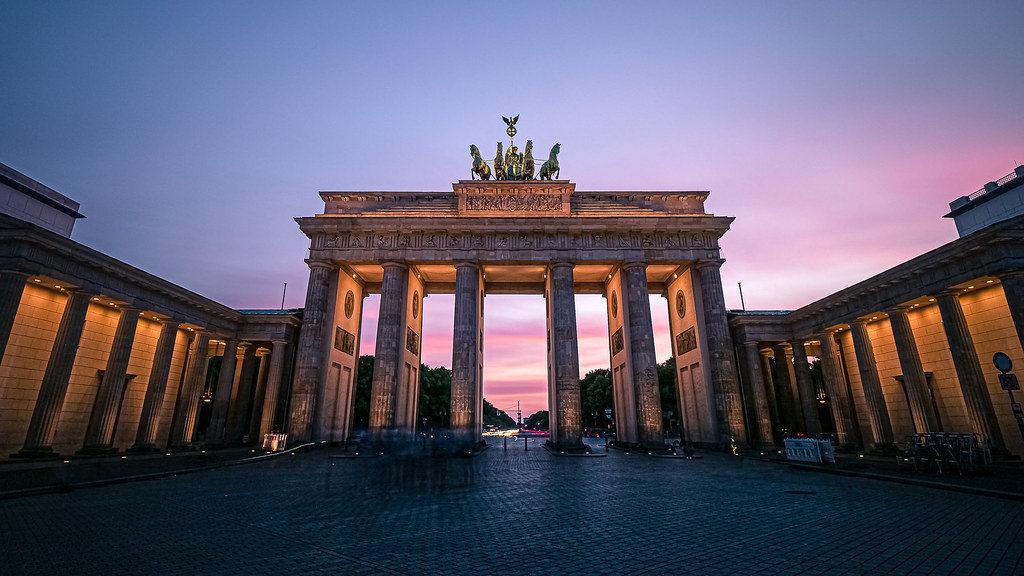
Twelve columns and, up top, the Quadriga — a goddess driving a four-horse chariot. Napoleon admired her enough to cart her off to Paris in 1806; Prussia won her back eight years later and gave her an iron cross for the homecoming. The Brandenburg Gate has witnessed every version of Germany that followed.
In January 1933, Nazi columns marched through here by torchlight to celebrate Hitler's rise. After 1961, the gate stood marooned in the Wall's death strip — walled off and unreachable, the very image of a divided nation. Then, in November 1989, Berliners climbed the Wall and danced where the guards had stood.
Look around Pariser Platz today, at the banks, embassies and hotels, and remember that almost all of it was empty ground just thirty-five years ago. The gate endured; everything around it had to be imagined again.
A Field Designed to Be Felt, Not Explained
Two thousand seven hundred and eleven concrete slabs, laid in a grid over ground that rolls like a swell at sea. Peter Eisenman's Memorial to the Murdered Jews of Europe opened in 2005, and it rewards those who walk into it. At the edges the blocks sit low, like benches, but as you move toward the centre the floor drops, the slabs rise overhead, the city's noise falls away, and you lose sight of whoever you came with.
Eisenman refused to explain the symbolism. He wanted visitors to feel it in their bodies rather than read it on a plaque. Beneath the field, an information centre restores the names of the murdered — six million, recorded one family at a time.
A few hundred metres south, beneath an ordinary car park, lie the remains of Hitler's bunker. Deliberately, there is almost nothing to see there — just a small sign. No shrine. The contrast is itself the message.
The Square Built by Refugees
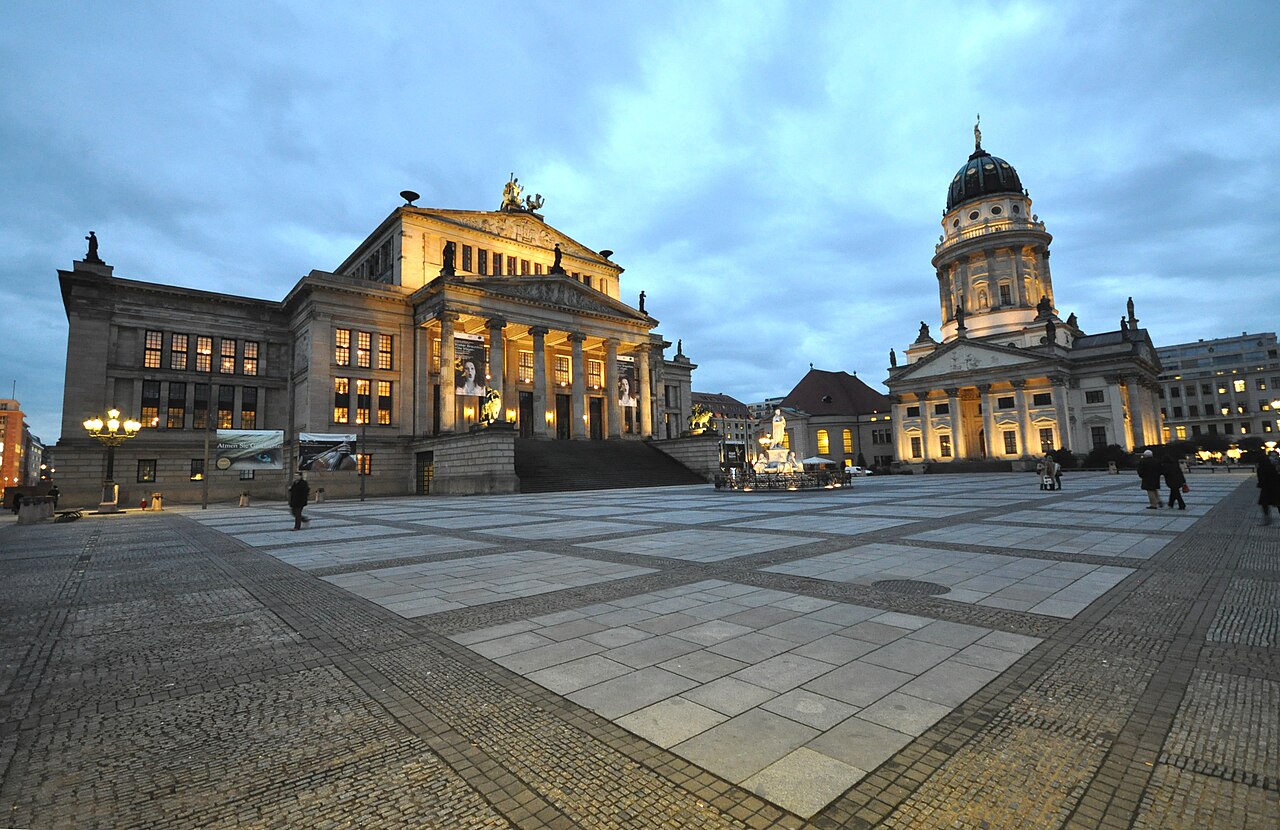
After the weight of the stelae field, Gendarmenmarkt arrives like a held breath released. Two near-identical domed churches face each other across what many consider Berlin's finest square, with Schinkel's elegant concert hall between them.
The church on the north side is the Französischer Dom, the French Cathedral — 'French,' here in Prussia, for a reason. In 1685, when France expelled its Protestant Huguenots, Prussia threw open its doors and welcomed thousands of refugees. They brought their crafts, trades and language; at one point perhaps one Berliner in five spoke French.
Set against everything else on this walk, it's a thread worth holding onto. This city was built, in part, by people fleeing persecution and being taken in. Migration didn't dilute Berlin — it made it.
An Empty Library Beneath the Cobbles
Bebelplatz looks like an ordinary open square until you find the pane of glass set into the cobbles and look down. Beneath your feet is a white room of empty bookshelves — enough shelving, it's said, for twenty thousand books. Micha Ullman's memorial marks what happened here on the night of 10 May 1933.
That night, students — the very people a university exists to teach — piled up works by Jewish, leftist and 'un-German' authors and burned them in the square, cheered on by the new regime. Among the authors were Freud, Marx, Einstein and Heinrich Mann; Erich Kästner stood in the crowd and watched his own books burn.
A nearby plaque carries a line written by the poet Heinrich Heine more than a century earlier: 'Where they burn books, they will in the end also burn people.' He meant it as a warning. Within a few streets and a few years, it came literally true.
Good to know
The route runs about 1.5 miles one-way from the Reichstag riverbank to the Neue Wache on Unter den Linden, with roughly 35–40 minutes of listening across eight stops; allow two to three hours to linger. The ground is flat and paved, though the Holocaust Memorial's stelae field slopes and is uneven underfoot. Wear comfortable shoes, and if you want to climb the Reichstag dome, book the free visit online in advance and bring photo ID.
The full walk also passes Memorial to Homosexuals Persecuted under Nazism, Neue Wache.
If this stretch of Mitte is on your Berlin list, the best way to walk it is with the free self-guided audio tour 'Power and Memory: From the Reichstag to the Neue Wache.' It threads these eight sites into a single moving argument about power and remembrance, timed to your own pace — just press play at the white crosses by the river and let the city tell its own story.
Take the free tour: Power and Memory: From the Reichstag to the Neue Wache →