Philadelphia, USA · 6 min read
Every Ivy League school likes to tell you it's old. But only one was dreamed up by a Founding Father — and not the pious, minister-training kind of college either. When Benjamin Franklin sketched his vision for a school in Philadelphia, he wanted something secular, practical, and useful: knowledge for a rising city, not sermons for a chosen few.
The curious thing is that Penn's West Philadelphia campus isn't where Franklin actually founded anything. The real 1740s beginnings happened in Center City, a couple of miles east, near where he's buried. So this leafy campus is something more interesting than a birthplace — it's a tribute, a place a later university built to gather itself around the memory of the man who started it all.
If you're wondering whether Penn is worth a wander on a Philadelphia trip, the answer is yes — precisely because Franklin is everywhere here, at eye level, in bronze and brick and even a giant comic button. Here's how to read the campus like the homage it is.
The Runaway Before the Legend
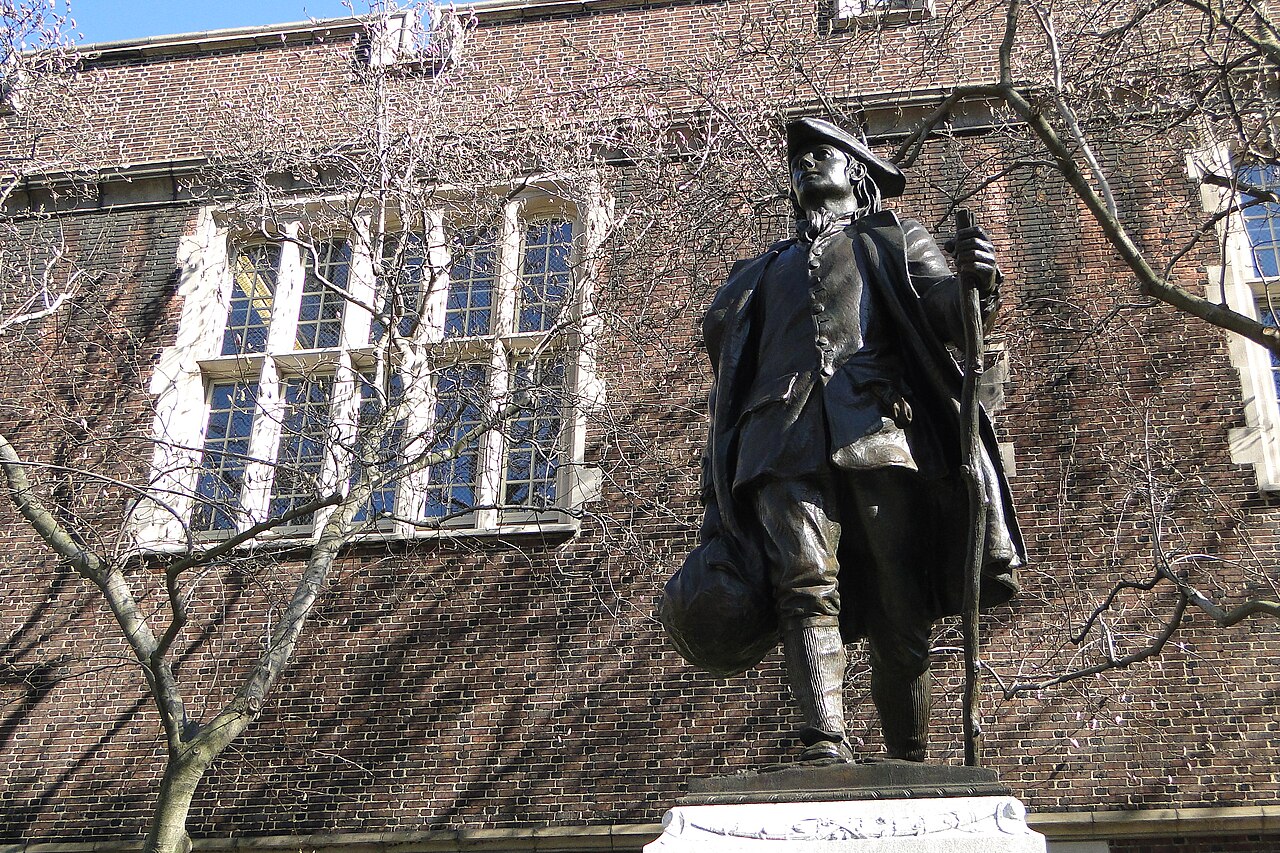
Most of us picture Franklin as the bespectacled sage on the hundred-dollar bill. R. Tait McKenzie's 1914 bronze near Weightman Hall insists on someone else entirely: the seventeen-year-old who walked into Philadelphia in 1723, a runaway from his brother's Boston print shop, carrying a couple of rolls of bread and, by his own admission, almost nothing else.
The face is worth lingering on. There's raw ambition in it, and the watchful eye of a printer sizing up a room. Everything Franklin would become — inventor, diplomat, relentless civic schemer — grew out of this self-made apprentice. Starting a Franklin tour with him young, hungry, and unproven sets up the whole story to come: the outsider who would build the outlier among America's colleges.
Franklin Made Concrete
If Franklin's spirit ever poured itself into stadium seating, it's here. Franklin Field was the first double-decker college football stadium in the country and has hosted the Penn Relays — one of track's oldest and largest meets — since 1895. The man who organized fire companies, lending libraries, and a hospital would have loved a great civic gathering place built purely for use.
But the eastern edge of the field is also the tour's moment of honesty. Look past the stands, across the Schuylkill River, and you're looking toward the truth: this campus only dates to the 1870s. Franklin's actual university began in the 1740s in Center City, where he now lies in the Christ Church burial ground, his grave still scattered with pennies tossed by visitors. Everything on this green campus is a kind of homage — a later Penn's way of keeping its founder close.
America's First Student Union
Houston Hall, opened in 1896, was the first college student union building in the United States — a place where students could eat, meet, argue, and simply be together instead of scattering to boarding houses between lectures. It's a handsome brick answer to a very Franklinian question: what if learning were communal and practical rather than solitary and pious?
The echo runs all the way back to Boston. As a young tradesman, Franklin founded a club he called the Junto, where clerks and craftsmen met to debate ideas and improve themselves and their city. Houston Hall is that same instinct scaled up and made permanent. Franklin never saw the building, but he'd have recognized its spirit the moment he stepped inside.
The Sage on the Green (and a Gothic Rumor)
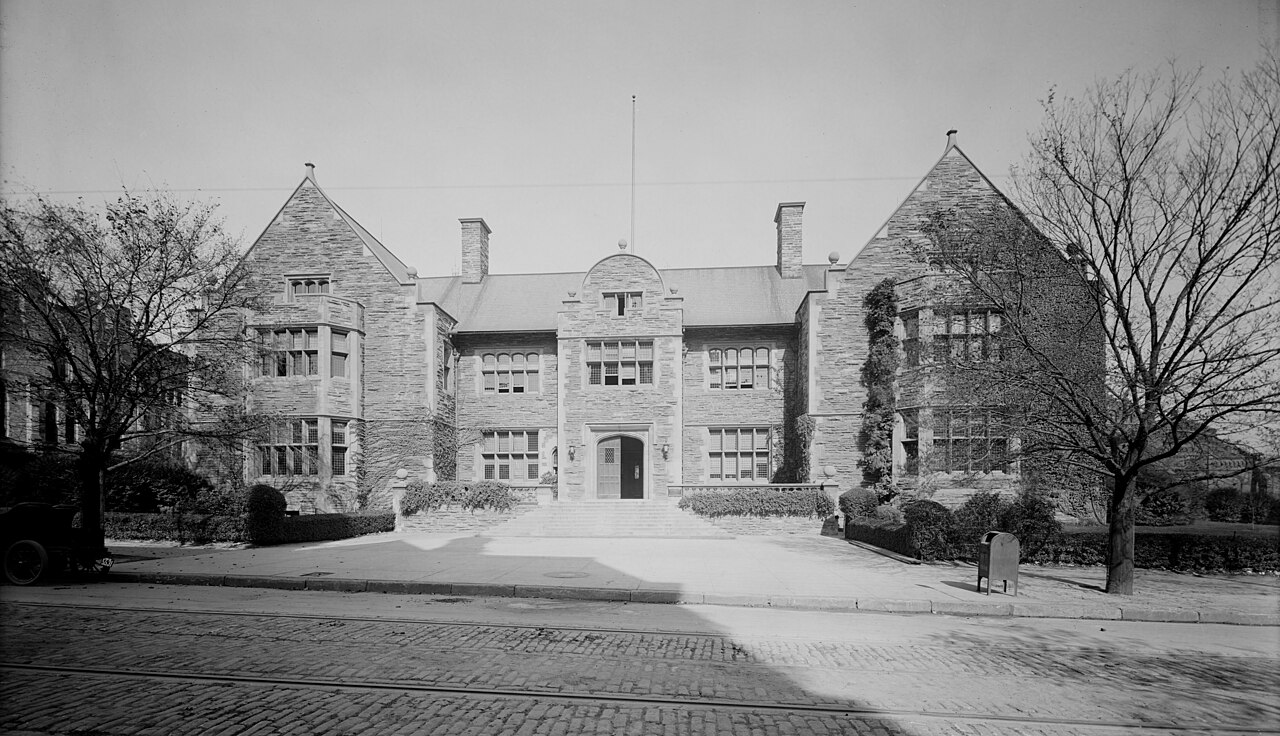
College Hall, built in 1872, is the oldest building on the West Philadelphia campus — the anchor from when the university packed up and moved west. Its green serpentine stone has weathered to a moody grey-green, and campus legend holds that alumnus Charles Addams drew on this very building for the gloomy mansion of the Addams Family. It's a fond rumor more than documented fact, but stand here on an overcast afternoon and you'll forgive everyone who believes it.
Out front sits John Boyle's 1899 bronze of Franklin — older now, the sage rather than the runaway, presiding over the green. This is the quiet poetry of the place: the university moved west and arranged itself around a founder who never set foot here, so that Franklin sits at its literal heart.
A Great Library and a Giant Button
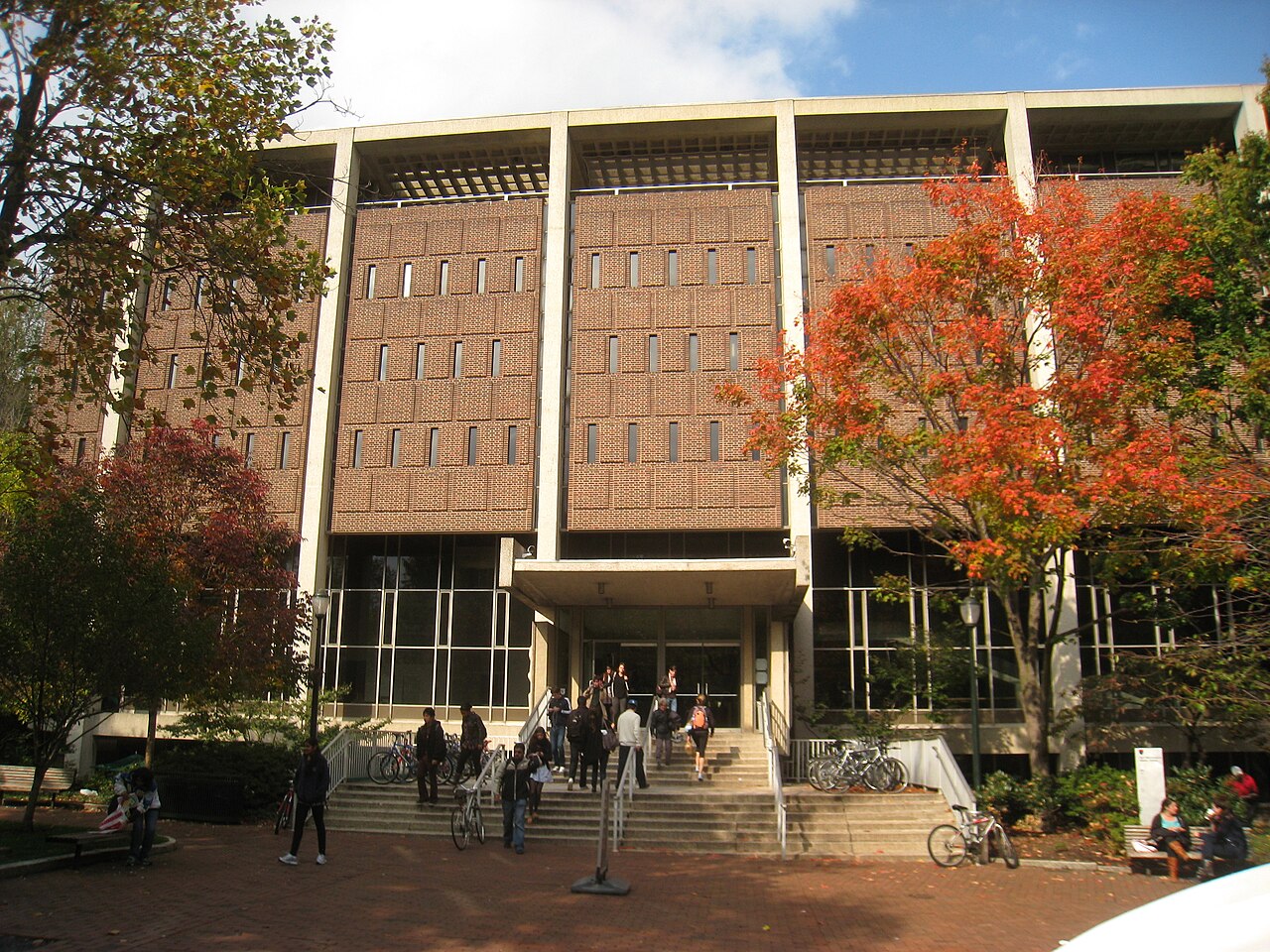
If any building honors Franklin's deepest love, it's Van Pelt, the university's main research library. Remember that he founded America's first subscription lending library so ordinary tradesmen could reach books they'd never afford alone. Here that reverence for useful knowledge is scaled up to millions of volumes.
Then, on the green, comes the joke: Claes Oldenburg's giant Split Button, cracked into four huge pieces and tilted as if dropped by a careless giant. One reading says it's a button popped clean off the portly founder's waistcoat. It's a perfect pairing — a monumental library beside a comic sculpture — because Franklin was serious about knowledge but never solemn about himself. This was a man who wrote fart jokes and mock epitaphs, and both halves of him live side by side on this lawn.
Take a Seat Beside the Founder
The walk ends on Locust Walk, the car-free spine of the campus and exactly the kind of open, sociable public space Franklin's civic imagination would have adored. Where the paths cross, look down for the Compass, a brass inlay marking the heart of campus. Students insist you shouldn't step on it before an exam — a superstition the empiricist in Franklin might have questioned and the storyteller in him would happily have kept alive.
A few steps on, there he is one last time: George Lundeen's 1987 'Ben on the Bench.' No pedestal now — just Franklin sitting with a newspaper, a space left open beside him. Sit down. The campus began with him young and empty-handed by the river and leaves him easy, approachable, and still reading. That's the whole arc of the place: a founder kept close, at eye level, always glad of company.
Good to know
The route runs a comfortable mile or so across Penn's West Philadelphia campus, easily walked in about an hour at a strolling pace — longer if you linger at the library green or on Locust Walk. Paths are flat and mostly pedestrian, so wear comfortable shoes. It pairs beautifully with a follow-up trip to Center City, where Franklin's real founding ground and his grave at Christ Church sit a couple of miles east.
If this walk sounds like your kind of afternoon, the free self-guided audio tour 'Penn: Franklin's University' is the ideal companion — six stops that trace Franklin from the runaway by the river to the sage on the bench, with the stories, legends, and honest asides narrated as you go. Pop in your headphones, start at the young Franklin statue, and let it lead you across campus at your own pace.
Take the free tour: Penn: Franklin's University →