Berlin, Germany · 5 min read
Most cities hand their history over in neat layers. Berlin shoves it all onto the same half-mile, where kings, Nazis, Communists and capitalists each tried to stamp their idea on the identical stretch of pavement — then erased whatever came before. The result is a stretch of central Berlin where a rebuilt baroque palace stares across an open plaza at a Communist TV tower, and almost nothing is quite as old as it looks.
If you're wondering whether this slice of Mitte is worth your time beyond a Museum Island ticket, it is — precisely because of how much it contradicts itself. Peace and brutality share a single lawn here. Dynasties the state tried to dynamite sleep quietly in crypts just up the road.
This is a guide to the most compelling stops between the Humboldt Forum and the Fernsehturm, and how to read a landscape that keeps rewriting itself.
The Palace That Keeps Dying and Coming Back
Stand in front of the Humboldt Forum and you'd swear the baroque stone had weathered three centuries of Berlin rain. It hasn't. These facades were finished in 2020 — a reconstructed shell wrapped around a thoroughly modern museum.
The spot itself is the tour's whole thesis in miniature. For centuries the Hohenzollern kings ruled from a palace here. The GDR dynamited its war-damaged ruins in 1950, then built the bronze-glass Palace of the Republic in its place — bowling alleys and all, nicknamed 'Erich's lamp shop.' That too came down, riddled with asbestos, after reunification. Now the palace is back, sort of.
Inside sit treasures from Africa and Asia, many taken during the colonial era, and the argument over who owns them and who gets to tell their story is nowhere near settled. Four centuries of rulers, and still nobody has stopped rewriting this one patch of ground.
Beauty and Brutality in a Single Garden
The Lustgarten — literally the 'pleasure garden' — looks benign enough today, a lawn full of people stretched out in the sun with Schinkel's templelike Altes Museum colonnade as a backdrop. This is where Museum Island, now a UNESCO site, began.
But the same lawn has worn darker uniforms. The Nazis paved it into a stone parade ground for rallies and marching boots; the GDR later held its own rallies on the identical square. Same ground, different flags.
It's also where, in May 1942, a Nazi propaganda exhibition mocking the Soviet Union was set alight by a small resistance group of young Jewish Communists led by Herbert Baum. Most were caught. Most were executed, barely out of their twenties. The tour asks you to remember their names here if you remember anything — a quiet counterweight to all the imperial grandeur nearby.
A Kaiser's Church and the Dynasty Below It
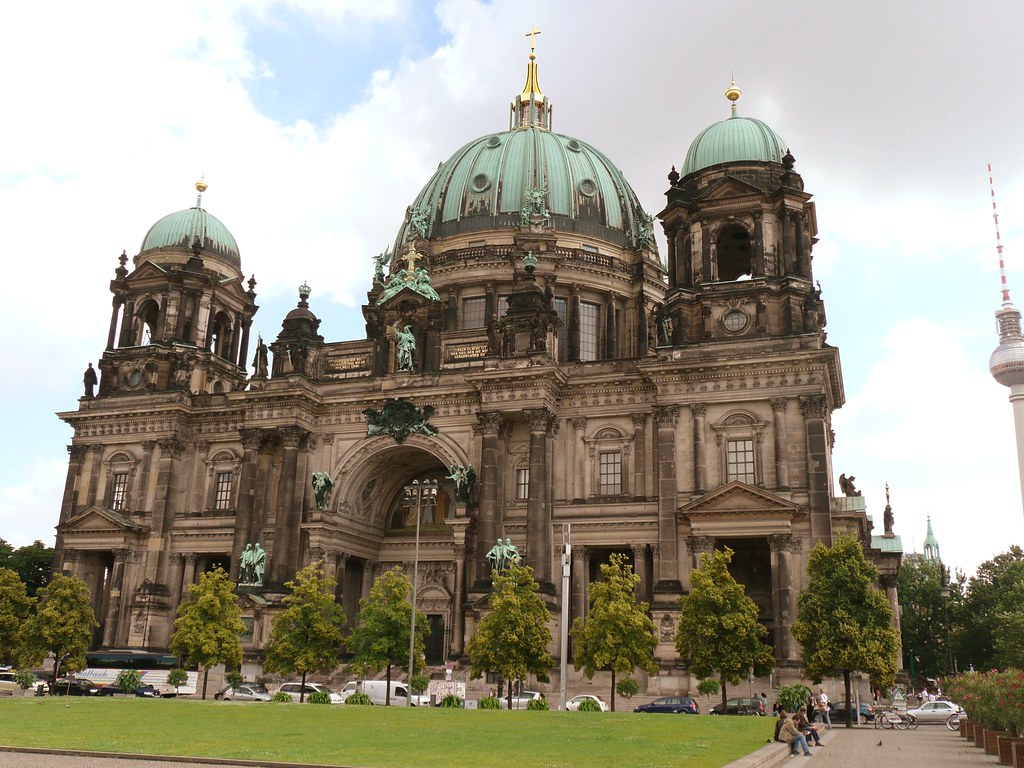
Berlin Cathedral is not a subtle building. Kaiser Wilhelm II put it up in 1905 as a Protestant answer to St Peter's in Rome, a statement that the Hohenzollerns and their empire could match anyone. Restraint was not his strong suit.
The war gutted it — the dome burned, a bomb punched clean through — and for decades it stood half-ruined. The GDR, unsurprisingly, felt no urgency to restore a Kaiser's church; serious work only began in 1975 and dragged on past reunification.
The quiet twist lies in the crypt beneath the floor, where around ninety Hohenzollerns rest — kings, queens, children in small coffins. The very dynasty the GDR tried to erase just up the road at the palace sleeps on here, undisturbed. Stone, it turns out, tends to outlast ideology.
The Old Pensioners of the Revolution
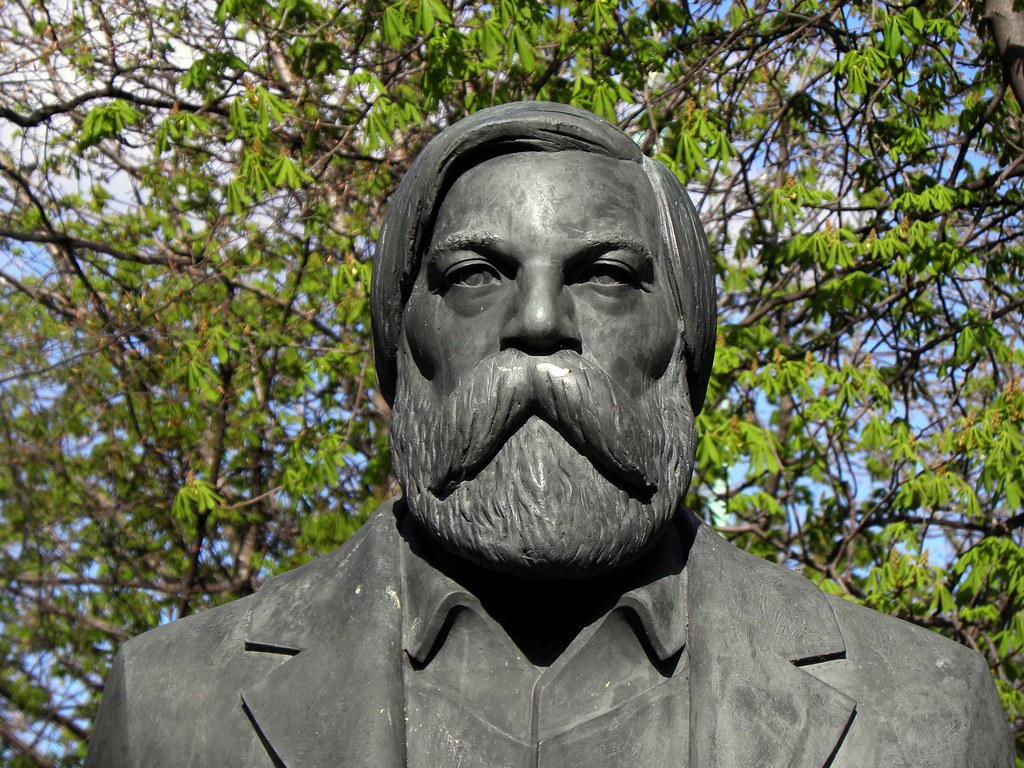
Karl Marx sits, Friedrich Engels stands, both cast in bronze and larger than life, gazing east across their open plaza. Berliners have never been able to resist them, nicknaming the pair 'the old pensioners.' When the Wall fell, someone sprayed on the base: 'We're sorry. Next time it'll be better.'
The GDR unveiled the monument in 1986, near the end of a country that didn't yet know it was ending. The open ground around it is deceptive too: before the war a dense old quarter of tangled lanes and tenements stood here, bombed and then deliberately cleared to make room for the socialist city.
Since reunification the statues have been shuffled around for building works — Marx and Engels relocated, as the tour wryly notes, by the very capitalism they predicted would fall.
Stop 5
The Medieval Survivor on a Socialist Plaza
St Mary's Church — the Marienkirche — looks almost lost out in all that open socialist space, a thirteenth-century stone survivor that predates Prussia, the Kaiser and everything that followed. It once sat in a medieval warren of streets long since swept away.
Step inside, if the door is open, and near the entrance you'll find a faded wall painting: a Dance of Death, the Totentanz, in which skeletons lead away pope and emperor, merchant and peasant alike — everyone equal in the end. It was painted after the plague, when death was never far off.
The tour doesn't prettify the rest. Like many churches of its age, the Marienkirche carries an ugly antisemitic carving, a reminder of the hatred medieval Christians preached against their Jewish neighbors — the same deep-rooted hatred that runs, centuries later, to the Baum group's story back in the Lustgarten. Honesty here means looking at both the beauty and the ugliness.
Good to know
The full route runs about 0.8 miles with seven stops, flat and paved throughout, and the audio comes to roughly 30 minutes of listening — budget an hour or more if you linger at Museum Island or step inside the churches. Try to time your walk to reach the Fernsehturm around sunset for the best city views, and note that tower tickets are timed, so book ahead. Comfortable shoes and a bit of patience for crowds around Museum Island are all you really need.
The full walk also passes TV Tower (Fernsehturm).
If this stretch of Berlin sounds like your kind of history — contradictory, layered and refreshingly honest — the free self-guided audio tour 'Palace to Plattenbau: Museum Island to the TV Tower' is the ideal way to walk it. Narrated with warmth and dry humor, it threads these stops into a single story and lands you at the Fernsehturm just in time for the view. Load it up, start at the Humboldt Forum, and let four centuries unfold at your own pace.
Take the free tour: Palace to Plattenbau: Museum Island to the TV Tower →