Ibiza, Spain · 6 min read
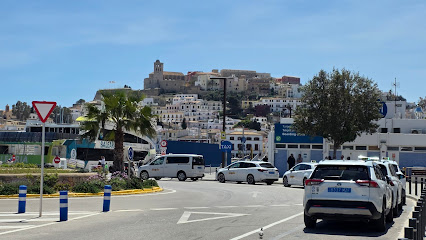
Say "Ibiza" and most people picture superclubs and sunrise DJ sets. But turn your back on the marina and look up, and you'll see the other Ibiza — a hill crowned in golden Renaissance stone that Phoenicians, Romans, Moors, and Catalans all spilled blood to control. This is Dalt Vila, the "high town," and it's a UNESCO World Heritage fortress that predates almost everything you think you know about the island.
Walking up through it is like flipping through the pages of the Mediterranean's history in reverse — from a 19th-century boulevard to a 16th-century military gateway to a Phoenician cemetery older than the Roman Empire. It's the most rewarding half-day any culture-minded visitor can spend here, and it's almost entirely free.
Here's how to trace that story yourself, stop by stop, from the waterfront up to the walls and out the other side.
The Gate That Recycled an Empire
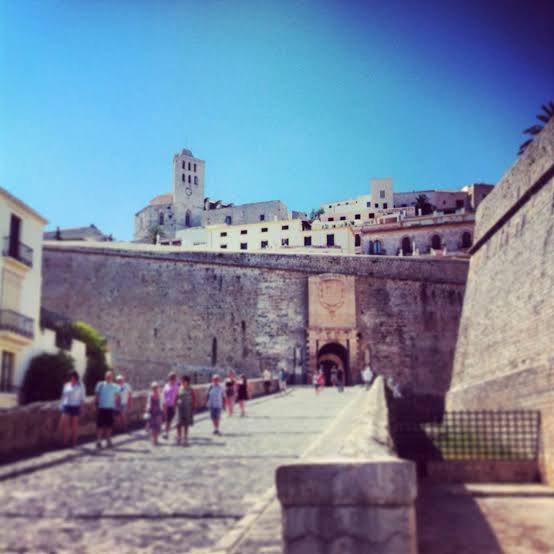
The Portal de ses Taules has guarded the main entrance to Dalt Vila since 1585, and it announces exactly what kind of place you're about to enter. The walls it pierces are two meters thick — engineered to shrug off cannon fire after a devastating Ottoman raid convinced the Spanish crown that Ibiza needed serious defenses, not just a crumbling medieval wall.
The telling detail is the pair of headless Roman statues flanking the entrance. They weren't imported for decoration; they were dug up right here during the gate's construction, and the builders simply propped them up where they'd been found. One empire's leftovers, reused to dress the walls of another — it's the whole logic of Dalt Vila in a single gesture. Above them sits the coat of arms of Philip II of Spain, who ordered the fortifications built.
Cross the threshold and you're not entering a quaint old neighborhood so much as stepping inside a 16th-century military machine that happens to have aged beautifully.
An Arsenal Turned Art Gallery
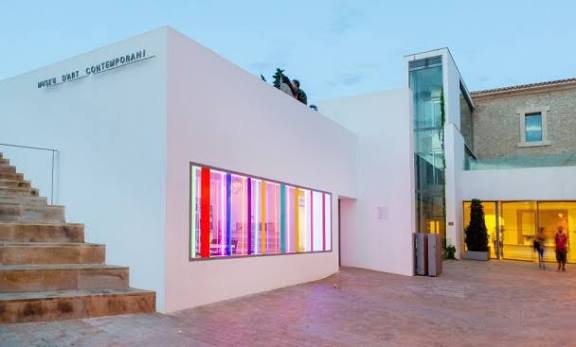
MACE, Ibiza's contemporary art museum, occupies one of the fortress's old weapons stores — a building that once held gunpowder, cannonballs, and muskets rather than canvases. Its vaulted stone ceilings weren't chosen for their looks; they were engineered to be fireproof and blast-resistant, practical architecture for a room full of explosives.
That quiet transformation — from a tool of war to a home for art — is the recurring pattern of Dalt Vila, and here it carries an extra layer of meaning. The museum opened in the 1970s and its collection leans toward artists who lived and worked on the island, many of them refugees who fled Franco's Spain and found in Ibiza a rare pocket of freedom. A room built to store the instruments of defense now holds the work of people who came searching for its opposite.
The Summit Everyone Fought For
The climb pays off at the Castell d'Eivissa and its old parade ground, the Plaça d'Armes — the highest point of the citadel. Turn slowly and you'll understand every siege in Ibiza's history in a single sweep: the port where ferries still dock, the salt flats shimmering to the south, and on a clear day the low outline of Formentera across the water. Whoever held this rock held the entire approach to the island.
That's precisely why something has stood fortified here since Moorish rule, centuries before the Renaissance walls were even imagined. The castle has been rebuilt and expanded so many times — by Muslim governors, then Catalan conquerors, then Spanish military engineers — that its walls read like a cross-section of the island's political history, one era stacked on the next. Few spots anywhere let you take in this much land and sea at once.
Sacred Ground That Keeps Changing Gods
Crowning the very peak of the hill, the Cathedral of Santa María has stood here since the Christian conquest of 1235 — but the conquerors didn't build on empty ground. This site had already held a Roman temple, and before that, in all likelihood, a Phoenician or Punic shrine. For over two thousand years, sacred ground here has simply changed hands and changed gods, generation after generation.
What you see today is really two buildings fused into one. The squat, fortress-like Gothic core dates from the 1300s and was built as much to withstand a siege as to hold a service. The lighter, more ornamental Baroque interior came centuries later, once the constant fear of attack had finally eased. Step inside for a moment of cool, candlelit quiet — then walk to the terrace edge, where the rooftops tumble down toward the harbor and the sea stretches wide.
The Arrowhead That Changed Warfare
Out on the Baluard de Sant Pere, look down at the shape beneath your feet: an arrowhead point jutting out from the wall. This is a bastion, and its geometry represents a genuine revolution in fortress-building across 16th-century Europe. Straight medieval walls left defenders blind to attackers pressed right against the base of the stone. These angled, projecting bastions eliminated that blind spot, letting soldiers rake gunfire along the entire face of the neighboring walls.
Dalt Vila has seven of them, and together they made the city one of the most advanced fortified ports in the whole Mediterranean — engineered with Ottoman and Barbary raiders specifically in mind. The threat vanished long ago, but the view the engineers built to defend endures as one of the finest in Ibiza.
Where the Story Actually Begins
The walk ends where Ibiza's history truly starts: the Necropolis of Puig des Molins, the "Hill of the Windmills," one of the largest and best-preserved Phoenician and Punic burial grounds anywhere on earth. Beneath this hillside lie close to three thousand tombs, cut into the soft rock beginning in the 600s BC — not long after Phoenician settlers first founded the city on the hill you've just descended from.
As was their custom, they kept the city of the living and the city of the dead close but clearly separated, a short walk apart — much like the one you've just made. Generation after generation kept using the ground: Phoenicians, then Carthaginians, then Romans, right up until around 700 AD. Their names are mostly lost, but the objects buried alongside them — jewelry, painted ostrich eggs, a striking bust of the goddess Tanit — reveal people who cared deeply about being remembered. From a Renaissance fortress to a two-thousand-year-old cemetery, that's the full arc of Ibiza in a single afternoon's walk.
Good to know
Plan on roughly two to three hours at an unhurried pace, though the route is entirely walkable in an afternoon. It runs from the Estació Marítima on the waterfront up through Dalt Vila to the Puig des Molins necropolis — mostly uphill on cobblestones and stairs, so wear proper shoes and bring water, especially in summer. The climb to the castle and cathedral is the steepest stretch. Time your visit for late afternoon to catch the golden light on the walls and cooler temperatures, and check opening hours for MACE, the cathedral, and the necropolis museum if you want to go inside.
The full walk also passes Estació Marítima Eivissa, Formentera i València, Passeig de Vara de Rey, Mercat Vell (Old Market), Plaça de Vila, Mirador de la Plaza de España.
The easiest way to actually understand what you're looking at — rather than just admiring pretty white walls — is to let the history come to you as you climb. The free self-guided audio tour "Ibiza's Walled City of Empires" walks you from the ferry terminal all the way up to the Phoenician necropolis, unfolding 2,700 years of sieges, empires, and reinvention at each stop along the way. Download it, pop in your headphones, and let Dalt Vila tell its own story.
Take the free tour: Ibiza's Walled City of Empires →