Budapest, Hungary · 6 min read
There is no district in Budapest quite like the seventh. Within a few walkable blocks, District VII contains the largest synagogue in Europe, a garden of mass graves, a surviving fragment of a wartime ghetto wall — and, a few doors down, some of the most famous bars on the continent. It is a neighborhood that refuses to be one thing.
Most visitors come for the ruin bars and stumble, almost by accident, into the memory that surrounds them. The truth is that both stories share the same stones, the same courtyards, the same addresses. That tension isn't a flaw in the quarter — it's the whole point of it.
If you're deciding whether the Jewish Quarter is worth your time in Budapest, the honest answer is that it might be the most emotionally complicated few hours you'll spend in the city. Here's what to look for, and why it stays with you.
A Cathedral That Wanted to Belong
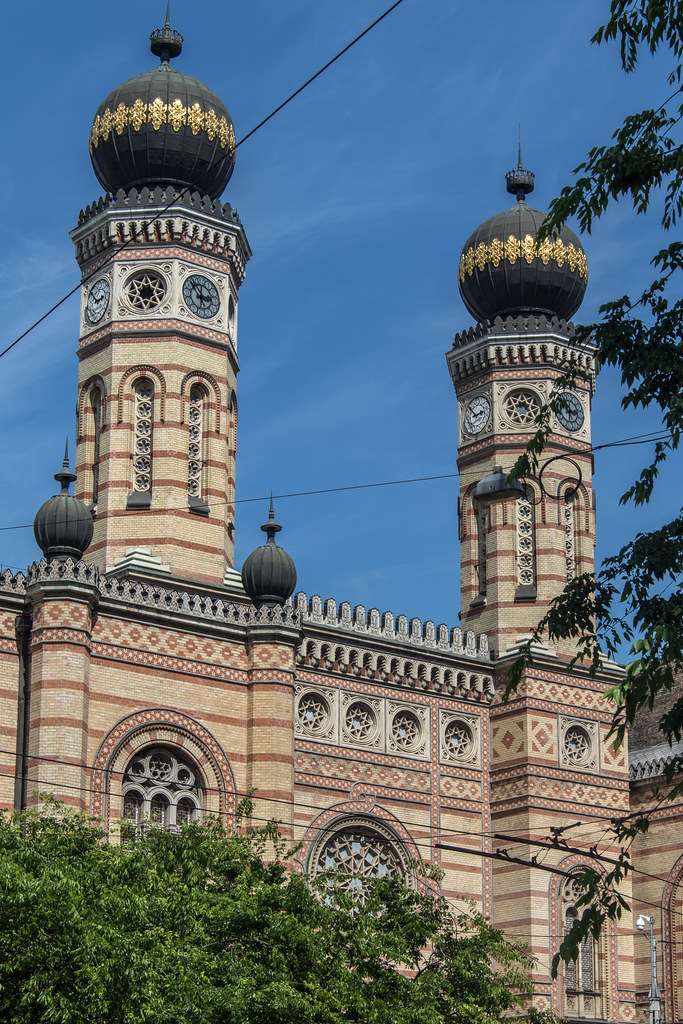
The Dohány Street Synagogue is the largest in Europe, consecrated in 1859, and it looks nothing like what you might expect a synagogue to look like. Twin onion-domed towers, a rose window, a nave you could mistake for a cathedral — every architectural choice was deliberate. This is the seat of Neolog Judaism, a distinctly Hungarian movement that sought a place inside modern Hungarian society without ceasing to be Jewish. The building was designed to say, quite literally, we belong here.
There's a poignant coincidence next door. In the house that once stood beside the synagogue, Theodor Herzl — the father of political Zionism — was born in 1860. Two answers to the same question, standing side by side: belong here, or build elsewhere.
And then history delivered its cruelest irony. In 1944, the Nazis made this synagogue's gates a boundary of the Pest ghetto. A building meant to declare belonging became a wall around people told they did not belong at all.
The Tree Where Every Leaf Is a Name
Behind the synagogue lies a garden that is, first and foremost, a cemetery — a fact worth absorbing before anything else. In the winter of 1944 and 1945, the ghetto had no way to bury its dead. When the Red Army reached these streets, thousands of bodies lay in the courtyards and along the walls. They were buried here, in mass graves, beneath the ground visitors now walk on.
Rising above them is the Tree of Life: a steel weeping willow with its branches bent downward. Look closely and you'll see that every leaf carries a name — each one a person killed in the Hungarian Holocaust. It is impossible to take in all at once, which is precisely the point.
The park bears the name of Raoul Wallenberg, the Swedish diplomat who issued protective papers and shielded tens of thousands of Budapest Jews — before vanishing into Soviet custody, never to return. It's a place to slow down, read a leaf, and stay as long as you need.
The Quietest Marks of the Largest Crimes
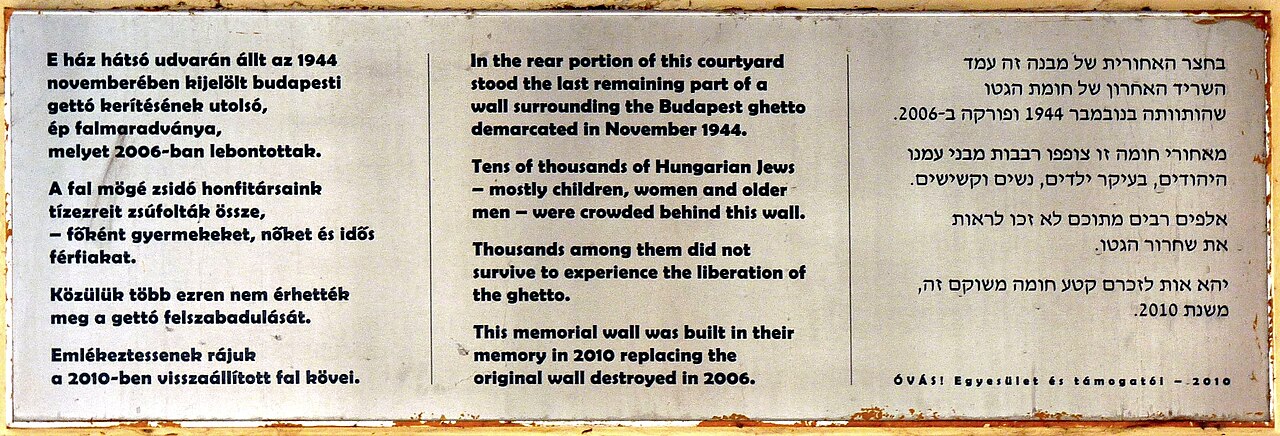
Tucked into an ordinary residential courtyard on Király utca — bicycles, windows, the everyday business of an apartment building — stands a reconstructed fragment of the wall that sealed the Pest ghetto in November 1944. It's easy to walk right past it.
The scale behind that modest plaque is staggering: roughly seventy thousand people forced into a few dozen blocks and sealed behind barriers like this one. The ghetto existed for only a matter of weeks before liberation, but cold, hunger, and disease killed thousands in that short span. Many of the names on the Tree of Life came from streets exactly like this.
There's something worth sitting with here — how small the marker is, how quietly the fact is stated. The largest crimes often leave the faintest traces. This one doesn't need a grand monument to be true.
Brilliance, Abandonment, and a Slow Return
The Rumbach Street Synagogue is a jewel that most tourists never notice: bands of ochre and rust-red brick, an octagonal footprint, Moorish arches. It was completed in 1872 by Otto Wagner, years before he became one of the great architects of Vienna. It was built for the Status Quo Ante congregation — the Jews who chose neither the Neolog path nor strict Orthodoxy, but to remain exactly as they had been before the community split.
Then the war emptied it. For decades after 1945, it stood derelict — its roof failing, pigeons in the sanctuary, a ruin waiting to be forgotten. That it survived at all feels like an accident of neglect rather than care.
In 2021, after a long restoration, it reopened, and its painted, star-strewn dome is once again worth craning your neck for. In a single building you can trace the entire arc of the quarter: brilliance, abandonment, and a slow, deliberate return.
Two Truths at the Same Address
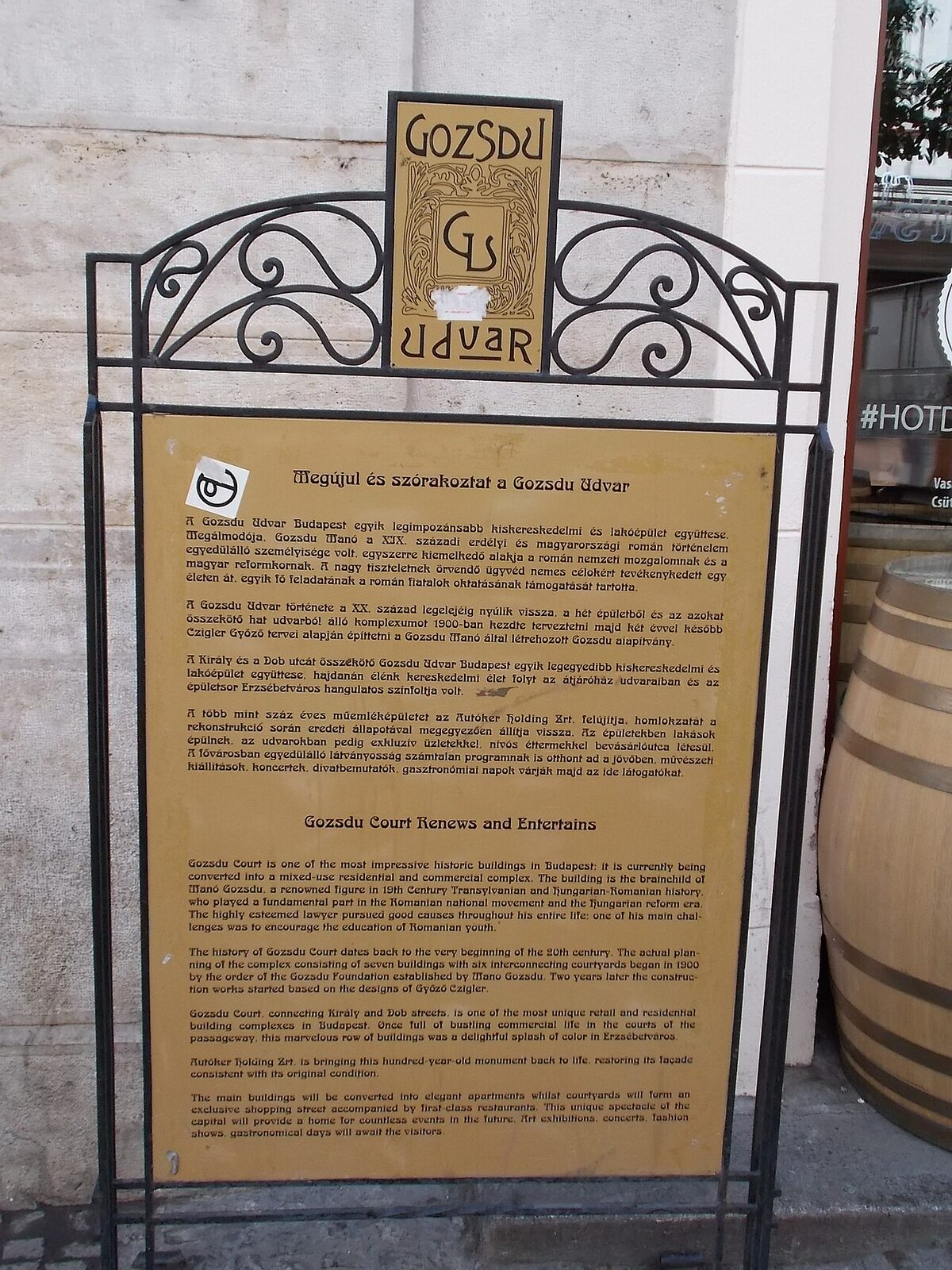
Gozsdu Udvar is a chain of seven connected courtyards threading an entire block from Király utca through to Dob utca. A century ago the passage hummed with workshops and small trades — tailors, watchmakers, merchants, much of it Jewish. In 1944 these same courtyards fell inside the ghetto boundary, where people were crowded together behind walls, in fear.
Today it is one of the densest nightlife corridors in the city: bars, terraces, music spilling from open doors, the passage packed on a warm night. The temptation is to resolve the contradiction, to decide which story is the real one.
But the quarter refuses that. This was a place of confinement, and it is a place of pleasure, in the same stones. The city didn't choose one narrative over the other — it let them occupy the same address. Walking through, it's worth holding that discomfort rather than smoothing it away.
The Building That Outlasted Its People
Between the party and the memorials stands the Kazinczy Street Orthodox Synagogue, its sweeping 1913 Art Nouveau facade all flowing lines and quiet confidence. It was never just a synagogue. On this street stood a whole world — the house of prayer, a school, a mikveh for ritual bathing, a kosher kitchen. Everything a devout life required, within a few steps.
It too stood inside the ghetto, and here is the part hardest to hold: the building survived, but the community, largely, did not. The stones outlasted the people who filled them. And yet, unlike the restored-but-emptied Rumbach dome, this remains an active, functioning Orthodox synagogue. Prayers are still said here. After everything, a thread of that world was never fully cut.
Good to know
The full route runs from the Dohány Street Synagogue to Szimpla Kert — a compact loop of roughly 1.5 km that most people cover in about two hours, longer if you go inside the synagogues or pause at the memorials. Wear comfortable shoes, bring water, and dress respectfully for the active houses of worship (some require covered shoulders and, for men, a head covering). Several synagogues charge admission and keep limited hours, so check ahead if you want to see the interiors. The ruin bars come alive after dark, but the memorial sites are best absorbed in daylight — consider timing your walk to end as evening falls.
The full walk also passes Szimpla Kert.
The best way to experience all of this — the belonging and the exclusion, the graves and the ruin bars — is the free self-guided audio tour "Budapest: The Jewish Quarter — Memory and Reinvention." It walks you from the Tree of Life to Szimpla Kert's doorway at your own pace, letting each stop's story land without rushing you to resolve the tension between them. Download it, put in your headphones, and let the quarter speak for itself.
Take the free tour: Budapest: The Jewish Quarter — Memory and Reinvention →