Budapest, Hungary · 7 min read
Some cities reveal themselves slowly, in fragments. Budapest lays it all out along a single street. Andrássy út runs arrow-straight from the downtown crossroads to a park full of monuments, and walking its length is the fastest way to understand what this city wanted to be — and everything that happened to it instead.
The story starts in 1896, the thousand-year anniversary of the Magyar tribes arriving in the Carpathian basin. Hungary marked the occasion by building a boulevard, a square, and a castle, all designed to announce a confident young nation to the great powers of Europe. Then the twentieth century arrived, and the same grand addresses became something darker.
This is a walk about ambition and memory in equal measure — leafy villa stretches and thermal palaces alongside the buildings where history turned cruel. Here's what to look for along the way, and how to end the whole thing soaking in hot water.
The Eight-Sided Crossroads That Kept Changing Its Name
The Oktogon is where the walk begins, and it's a fitting overture: an eight-sided plaza cut open in 1873, back when Budapest was busy reinventing itself as a capital worthy of an empire. Traffic wheels around all four grand corners as though it owns the place. Andrássy út, the boulevard threading through it, was the city's great confidence statement — a Parisian avenue for a nation determined to be taken seriously.
It worked, right up until the century turned nasty. The square's own name tells that story in miniature. Over the decades it has been Mussolini tér, honoring a dictator, and November 7 tér, marking the Bolshevik revolution. Every regime that seized the city wanted its name stamped on this crossroads.
All of them lost. The shape stayed. There's an odd honesty in a square that ended up named simply for what it looks like — eight sides, no ideology attached.
Andrássy 60: The Same Cellars, Two Terrors
A short walk up the boulevard stands one of the most unsettling addresses in Europe. Look up at the roofline of Andrássy út 60 and you'll see a black blade of a cornice jutting out. At noon the sun throws its cut-out letters onto the stone below, and the word TERROR falls across the facade like a shadow that never quite lifts.
The reason to hold two thoughts at once here: in 1944 this was the headquarters of the Arrow Cross, Hungary's homegrown fascists, who murdered and deported their fellow citizens. Barely a year later the communist secret police, the ÁVH, moved into the very same rooms. Same cellars, same iron doors, the same work of fear — only the flag on the roof had changed.
That continuity is the whole point of the building, now a museum. The boulevard back at the Oktogon promised a golden future; this address is what the twentieth century did with that promise, twice over, from opposite ends of the political spectrum. People were tortured in the cellars below. It's a place that asks for a moment of quiet.
Where the Boulevard Exhales
Between the darkness of number 60 and the grandeur of Heroes' Square, the boulevard takes a breath at the Kodály körönd — a great circular clearing named for the composer Zoltán Kodály, who lived in one of the houses that frame it. Four bronze statues of Hungarian heroes keep watch over the traffic circling below.
Look at the sgraffito-decorated facades, the faded ochre and cream, the confident ornament. This is where Andrássy stops being a downtown boulevard and becomes something leafier: the villa stretch, all garden fences, plane trees, and embassies behind wrought iron. It's the address the golden age built for people who had already arrived.
Worth noticing, too, is how quickly the street lets you forget the terror you passed just minutes earlier — how easily grandeur returns to simply being pleasant. That forgetting is its own kind of history.
Heroes' Square, and the Pedestals That Changed Their Minds
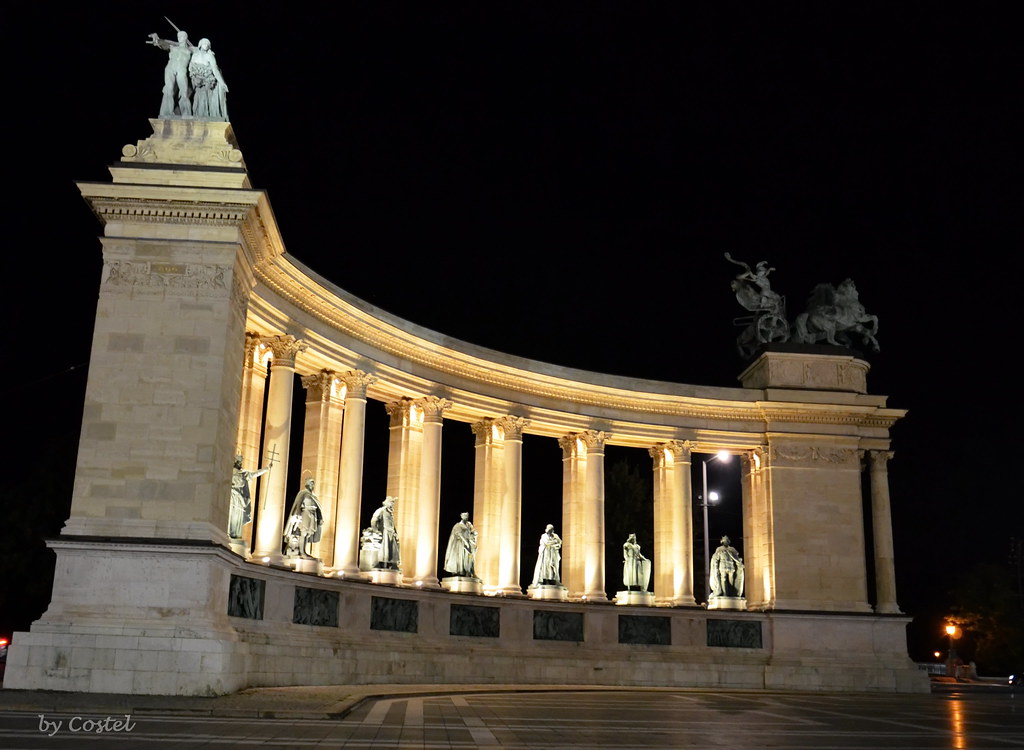
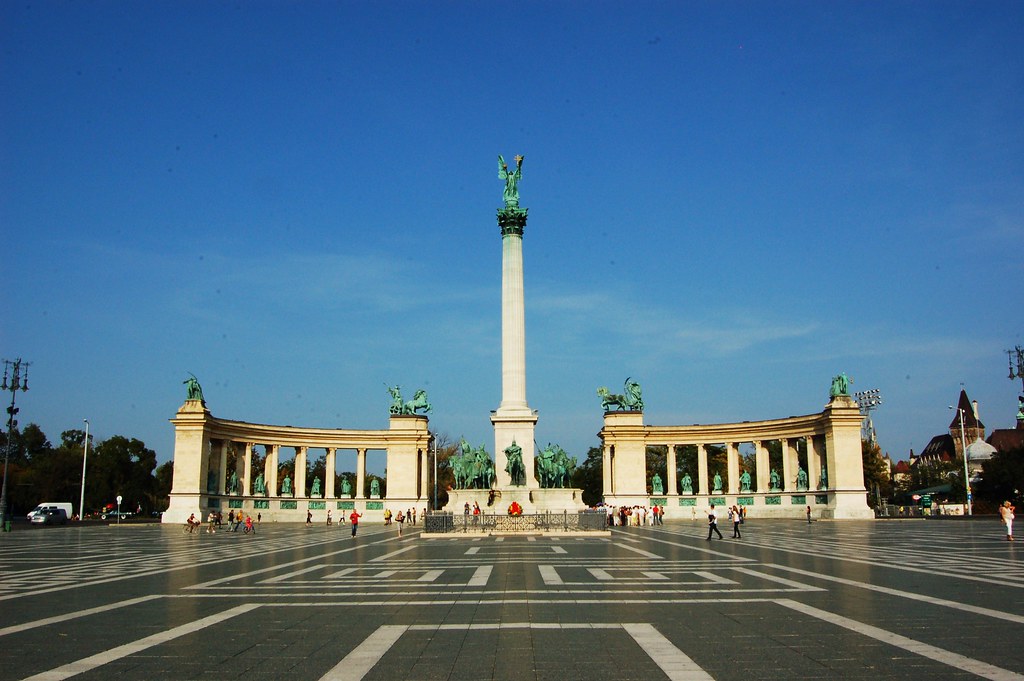
The boulevard ends with an exclamation point. Heroes' Square was built for 1896, and everything about it is designed to make a statement. At its center rises a column crowned by the Archangel Gabriel holding the crown of Saint Stephen. Below stand the seven Magyar chieftains on horseback, Árpád at the front, the founding fathers of the nation staring down a thousand years of history.
The colonnades curving behind them were designed to hold Hungary's greatest kings — including the Habsburg emperors who ruled from Vienna. But look at who occupies the pedestals now. After the wars, the Habsburgs were quietly removed and replaced with freedom fighters and revolutionaries. Same pedestals, new heroes. It's the Oktogon trick again, this time carved in marble: every regime editing the monument to tell its own version of the story.
This is where Hungary comes to declare who it is. Crowds filled the square in 1896 to celebrate a millennium; in 1989 a quarter of a million people gathered here to rebury a martyred prime minister. Standing in that same space, you feel the weight of a country that keeps rewriting its own memorial.
The Fake Castle Budapest Loved Too Much to Tear Down
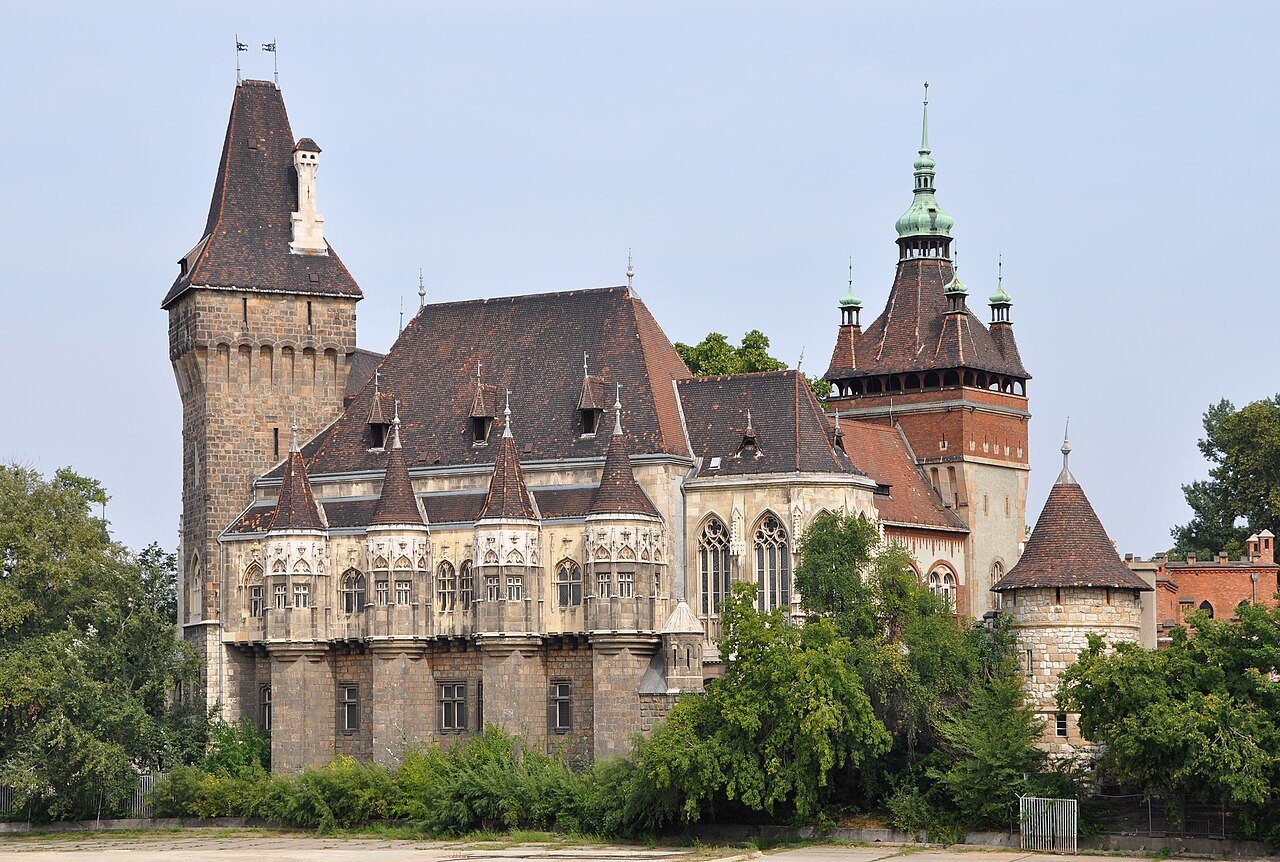
Just past the square sits what may be the city's most charming deception. Vajdahunyad Castle looks a thousand years old — Gothic spires, a Romanesque chapel, a Baroque wing, a Transylvanian tower — but it's all one building, and none of it began as real.
For the 1896 millennium fair, architects threw up a temporary pavilion of wood and cardboard, a greatest-hits collection stitching together every era of Hungarian architecture into a single fantasy. It was meant to be dismantled once the party ended. Instead the city fell in love with the counterfeit and rebuilt it permanently in brick and stone.
There's something wonderfully fitting about that: a nation celebrating its history by constructing a beautiful fake of it. Wander into the courtyard and find the hooded bronze statue of Anonymus, the medieval chronicler whose real name was never recorded. The whole confident swagger of 1896 lingers here, playing dress-up in the park.
Ending in Hot Water at the Széchenyi Baths
The walk finishes, quite literally, in hot water. The Széchenyi Baths opened in 1913 as a vast yellow neo-Baroque palace built over a thermal spring rising from more than a kilometre beneath the surface. The confident city didn't just raise boulevards and monuments — it plumbed the earth itself and made a palace of what it found.
On a cold day, steam lifts off the outdoor pools into the winter air while swimmers sit in it up to their shoulders, entirely unhurried. Old men set up chessboards on floating trays and play for hours in the heat. It's Budapest's warm underside surfacing — the city soaking in what it built.
It's the perfect coda to the boulevard's story. The Oktogon and its changing names, number 60 and its two terrors, the heroes swapped on their pedestals, the beloved fake castle: a golden age that promised the world in 1896 and then survived everything the century threw at it. And it's still here, still warm. Bring a swimsuit and you can end your walk in the water.
Good to know
The full route runs roughly 3.5 kilometres from the Oktogon to the Széchenyi Baths, largely flat and following Andrássy út its whole length — plan on about two to three hours at a strolling pace, more if you stop at the House of Terror museum or linger in the park. Wear comfortable shoes, bring water in summer and a warm layer in winter (the steaming outdoor pools are best in the cold), and pack a swimsuit and towel if you want to end in the baths. The M1 metro line runs directly beneath Andrássy if you need to shortcut any stretch.
If this is the walk you want to take, the free self-guided audio tour "Budapest: Andrássy to the Baths — The Golden Age Boulevard" is the ideal companion — it carries you from the Oktogon to the water with the stories, the wry asides, and the history woven in at each stop, at your own pace. Download it, put in your headphones, and let the boulevard tell you who Budapest wanted to be.
Take the free tour: Budapest: Andrássy to the Baths — The Golden Age Boulevard →